🚚 Free Worldwide Shipping on All Orders!Shop Now
American Classics - Carter: Symphony No 1, Etc / Wait, Et Al
Elliott Carter makes his Naxos début with an ear-catching programme
It’s very good news that Naxos has added Elliott Carter to its American Classics series, beginning with a strong programme of rarely heard pieces, and juxtaposing Carter in early populist vein with Carter the 1960s’ avant-gardist in full cry.
The wartime muscularity of the Symphony No 1 (completed in 1942 but heard here in its 1954 revision) is clearest in passages which echo, or anticipate, Copland’s more extrovert orchestral scores of the same period. But that triumphalist spirit is most productively on show in Carter’s splendidly brash Holiday Overture (1944). The Symphony as a whole is less straightforward, more varied in style and character, and the slow movement in particular moves from hymnic meditation into more ambiguous regions of expression in a manner that might not be completely convincing. It is certainly distinctive, however, and fits well with the balance between restraint and exuberance that typifies the work as a whole.
By the mid-1960s, when the Piano Concerto was composed, Carter’s language had shed its tonal roots, and his forms were far more distant from those traditions that are still traceable in the Symphony. Textures are immensely elaborate, yet the music is uninhibitedly dramatic, depicting all kinds of conflicts and attempted reconciliations while subjecting the basic concept of the concerto to penetrating critical scrutiny.
The power of the drama emerging from the constantly fluctuating confrontations between soloist, main orchestra, and a mediating concertino-group of seven players is rather muted in this recording, which (I suspect) is not the result of a preparatory series of public performances. Ursula Oppens, with Michael Gielen, managed to convey rather more of the music’s inherent fire and tumult. But Mark Wait shows a finely gauged technical command, and although Kenneth Schermerhorn and his Nashville players are occasionally underpowered and inclined to play safe, the jubilant conclusion of the Holiday Overture sweeps any interpretative reservations aside. With the symphony not otherwise available, this disc is a thoroughly recommendable addition to the Naxos American canon.
-- Arnold Whittall, Gramophone [3/2004]
It’s very good news that Naxos has added Elliott Carter to its American Classics series, beginning with a strong programme of rarely heard pieces, and juxtaposing Carter in early populist vein with Carter the 1960s’ avant-gardist in full cry.
The wartime muscularity of the Symphony No 1 (completed in 1942 but heard here in its 1954 revision) is clearest in passages which echo, or anticipate, Copland’s more extrovert orchestral scores of the same period. But that triumphalist spirit is most productively on show in Carter’s splendidly brash Holiday Overture (1944). The Symphony as a whole is less straightforward, more varied in style and character, and the slow movement in particular moves from hymnic meditation into more ambiguous regions of expression in a manner that might not be completely convincing. It is certainly distinctive, however, and fits well with the balance between restraint and exuberance that typifies the work as a whole.
By the mid-1960s, when the Piano Concerto was composed, Carter’s language had shed its tonal roots, and his forms were far more distant from those traditions that are still traceable in the Symphony. Textures are immensely elaborate, yet the music is uninhibitedly dramatic, depicting all kinds of conflicts and attempted reconciliations while subjecting the basic concept of the concerto to penetrating critical scrutiny.
The power of the drama emerging from the constantly fluctuating confrontations between soloist, main orchestra, and a mediating concertino-group of seven players is rather muted in this recording, which (I suspect) is not the result of a preparatory series of public performances. Ursula Oppens, with Michael Gielen, managed to convey rather more of the music’s inherent fire and tumult. But Mark Wait shows a finely gauged technical command, and although Kenneth Schermerhorn and his Nashville players are occasionally underpowered and inclined to play safe, the jubilant conclusion of the Holiday Overture sweeps any interpretative reservations aside. With the symphony not otherwise available, this disc is a thoroughly recommendable addition to the Naxos American canon.
-- Arnold Whittall, Gramophone [3/2004]
Product Information
Product Information
Shipping & Returns
Shipping & Returns
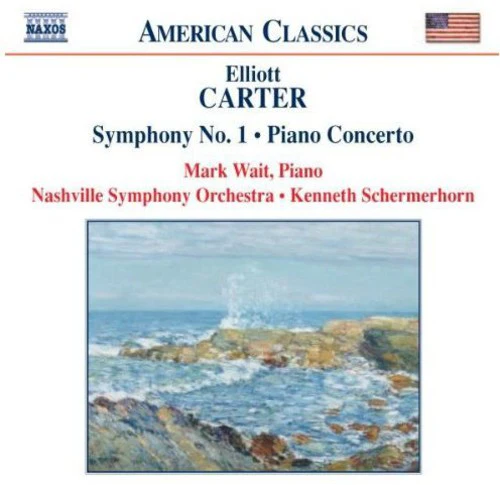

American Classics - Carter: Symphony No 1, Etc / Wait, Et Al
American Classics - Carter: Symphony No 1, Etc / Wait, Et Al
Elliott Carter makes his Naxos début with an ear-catching programme
It’s very good news that Naxos has added Elliott Carter to its American Classics series, beginning with a strong programme of rarely heard pieces, and juxtaposing Carter in early populist vein with Carter the 1960s’ avant-gardist in full cry.
The wartime muscularity of the Symphony No 1 (completed in 1942 but heard here in its 1954 revision) is clearest in passages which echo, or anticipate, Copland’s more extrovert orchestral scores of the same period. But that triumphalist spirit is most productively on show in Carter’s splendidly brash Holiday Overture (1944). The Symphony as a whole is less straightforward, more varied in style and character, and the slow movement in particular moves from hymnic meditation into more ambiguous regions of expression in a manner that might not be completely convincing. It is certainly distinctive, however, and fits well with the balance between restraint and exuberance that typifies the work as a whole.
By the mid-1960s, when the Piano Concerto was composed, Carter’s language had shed its tonal roots, and his forms were far more distant from those traditions that are still traceable in the Symphony. Textures are immensely elaborate, yet the music is uninhibitedly dramatic, depicting all kinds of conflicts and attempted reconciliations while subjecting the basic concept of the concerto to penetrating critical scrutiny.
The power of the drama emerging from the constantly fluctuating confrontations between soloist, main orchestra, and a mediating concertino-group of seven players is rather muted in this recording, which (I suspect) is not the result of a preparatory series of public performances. Ursula Oppens, with Michael Gielen, managed to convey rather more of the music’s inherent fire and tumult. But Mark Wait shows a finely gauged technical command, and although Kenneth Schermerhorn and his Nashville players are occasionally underpowered and inclined to play safe, the jubilant conclusion of the Holiday Overture sweeps any interpretative reservations aside. With the symphony not otherwise available, this disc is a thoroughly recommendable addition to the Naxos American canon.
-- Arnold Whittall, Gramophone [3/2004]
It’s very good news that Naxos has added Elliott Carter to its American Classics series, beginning with a strong programme of rarely heard pieces, and juxtaposing Carter in early populist vein with Carter the 1960s’ avant-gardist in full cry.
The wartime muscularity of the Symphony No 1 (completed in 1942 but heard here in its 1954 revision) is clearest in passages which echo, or anticipate, Copland’s more extrovert orchestral scores of the same period. But that triumphalist spirit is most productively on show in Carter’s splendidly brash Holiday Overture (1944). The Symphony as a whole is less straightforward, more varied in style and character, and the slow movement in particular moves from hymnic meditation into more ambiguous regions of expression in a manner that might not be completely convincing. It is certainly distinctive, however, and fits well with the balance between restraint and exuberance that typifies the work as a whole.
By the mid-1960s, when the Piano Concerto was composed, Carter’s language had shed its tonal roots, and his forms were far more distant from those traditions that are still traceable in the Symphony. Textures are immensely elaborate, yet the music is uninhibitedly dramatic, depicting all kinds of conflicts and attempted reconciliations while subjecting the basic concept of the concerto to penetrating critical scrutiny.
The power of the drama emerging from the constantly fluctuating confrontations between soloist, main orchestra, and a mediating concertino-group of seven players is rather muted in this recording, which (I suspect) is not the result of a preparatory series of public performances. Ursula Oppens, with Michael Gielen, managed to convey rather more of the music’s inherent fire and tumult. But Mark Wait shows a finely gauged technical command, and although Kenneth Schermerhorn and his Nashville players are occasionally underpowered and inclined to play safe, the jubilant conclusion of the Holiday Overture sweeps any interpretative reservations aside. With the symphony not otherwise available, this disc is a thoroughly recommendable addition to the Naxos American canon.
-- Arnold Whittall, Gramophone [3/2004]
$3.50
Original: $9.99
-65%American Classics - Carter: Symphony No 1, Etc / Wait, Et Al—
$9.99
$3.50Product Information
Product Information
Shipping & Returns
Shipping & Returns
Description
Elliott Carter makes his Naxos début with an ear-catching programme
It’s very good news that Naxos has added Elliott Carter to its American Classics series, beginning with a strong programme of rarely heard pieces, and juxtaposing Carter in early populist vein with Carter the 1960s’ avant-gardist in full cry.
The wartime muscularity of the Symphony No 1 (completed in 1942 but heard here in its 1954 revision) is clearest in passages which echo, or anticipate, Copland’s more extrovert orchestral scores of the same period. But that triumphalist spirit is most productively on show in Carter’s splendidly brash Holiday Overture (1944). The Symphony as a whole is less straightforward, more varied in style and character, and the slow movement in particular moves from hymnic meditation into more ambiguous regions of expression in a manner that might not be completely convincing. It is certainly distinctive, however, and fits well with the balance between restraint and exuberance that typifies the work as a whole.
By the mid-1960s, when the Piano Concerto was composed, Carter’s language had shed its tonal roots, and his forms were far more distant from those traditions that are still traceable in the Symphony. Textures are immensely elaborate, yet the music is uninhibitedly dramatic, depicting all kinds of conflicts and attempted reconciliations while subjecting the basic concept of the concerto to penetrating critical scrutiny.
The power of the drama emerging from the constantly fluctuating confrontations between soloist, main orchestra, and a mediating concertino-group of seven players is rather muted in this recording, which (I suspect) is not the result of a preparatory series of public performances. Ursula Oppens, with Michael Gielen, managed to convey rather more of the music’s inherent fire and tumult. But Mark Wait shows a finely gauged technical command, and although Kenneth Schermerhorn and his Nashville players are occasionally underpowered and inclined to play safe, the jubilant conclusion of the Holiday Overture sweeps any interpretative reservations aside. With the symphony not otherwise available, this disc is a thoroughly recommendable addition to the Naxos American canon.
-- Arnold Whittall, Gramophone [3/2004]
It’s very good news that Naxos has added Elliott Carter to its American Classics series, beginning with a strong programme of rarely heard pieces, and juxtaposing Carter in early populist vein with Carter the 1960s’ avant-gardist in full cry.
The wartime muscularity of the Symphony No 1 (completed in 1942 but heard here in its 1954 revision) is clearest in passages which echo, or anticipate, Copland’s more extrovert orchestral scores of the same period. But that triumphalist spirit is most productively on show in Carter’s splendidly brash Holiday Overture (1944). The Symphony as a whole is less straightforward, more varied in style and character, and the slow movement in particular moves from hymnic meditation into more ambiguous regions of expression in a manner that might not be completely convincing. It is certainly distinctive, however, and fits well with the balance between restraint and exuberance that typifies the work as a whole.
By the mid-1960s, when the Piano Concerto was composed, Carter’s language had shed its tonal roots, and his forms were far more distant from those traditions that are still traceable in the Symphony. Textures are immensely elaborate, yet the music is uninhibitedly dramatic, depicting all kinds of conflicts and attempted reconciliations while subjecting the basic concept of the concerto to penetrating critical scrutiny.
The power of the drama emerging from the constantly fluctuating confrontations between soloist, main orchestra, and a mediating concertino-group of seven players is rather muted in this recording, which (I suspect) is not the result of a preparatory series of public performances. Ursula Oppens, with Michael Gielen, managed to convey rather more of the music’s inherent fire and tumult. But Mark Wait shows a finely gauged technical command, and although Kenneth Schermerhorn and his Nashville players are occasionally underpowered and inclined to play safe, the jubilant conclusion of the Holiday Overture sweeps any interpretative reservations aside. With the symphony not otherwise available, this disc is a thoroughly recommendable addition to the Naxos American canon.
-- Arnold Whittall, Gramophone [3/2004]