🚚 Free Worldwide Shipping on All Orders!Shop Now
Verdi: Requiem / Price, Baker, Luchetti, van Dam, Solti, Chicago Symphony
Of Georg Solti’s two recordings of the Verdi Requiem, I slightly prefer this later one, though I realize that this isn’t received wisdom. The Decca recording, after all, features Sutherland, Horne, Pavarotti, and Talvela as soloists, and while Sutherland arguably is not the right voice for the part, everyone else is very good indeed. On the other hand, Leontyne Price, even toward the end of her career, certainly does have the right voice, as does Veriano Luchetti, while Baker and Van Dam are very intelligent singers by any measure, and they do a good job here. Besides, it’s hard not to raise an eyebrow at the generic complaint that “singer X lacks a true Italianate timbre” when the words being sung are in Latin and the drama (such as it is) occurs entirely within a devotional framework. The music certainly can take many different approaches, particularly when there’s so little actual agreement on what a “true Italianate timbre” is.
Also compared to the Decca recording, Solti here has the finer chorus, a better orchestra (for this work at least), and strangely enough, better (meaning less gimmicky) sound. Solti’s interpretation remains consistent, exciting, and direct, with a particularly thrilling account of the brief Sanctus and a Dies Irae chorus that is as violent as anyone could want without ever turning merely brutal or hysterical. A work as rich as this one always excites a wide range of opinions, and personal preferences tend to vary substantially. My personal favorite, all things considered, is the first Muti on EMI, with Scotto, Baltsa, Luchetti, Nesterenko, and the Philharmonia Orchestra; but either of Solti’s recordings are definitely among the select few. [12/17/2004]
– Classics Today (David Hurwitz)
Also compared to the Decca recording, Solti here has the finer chorus, a better orchestra (for this work at least), and strangely enough, better (meaning less gimmicky) sound. Solti’s interpretation remains consistent, exciting, and direct, with a particularly thrilling account of the brief Sanctus and a Dies Irae chorus that is as violent as anyone could want without ever turning merely brutal or hysterical. A work as rich as this one always excites a wide range of opinions, and personal preferences tend to vary substantially. My personal favorite, all things considered, is the first Muti on EMI, with Scotto, Baltsa, Luchetti, Nesterenko, and the Philharmonia Orchestra; but either of Solti’s recordings are definitely among the select few. [12/17/2004]
– Classics Today (David Hurwitz)
Product Information
Product Information
Shipping & Returns
Shipping & Returns
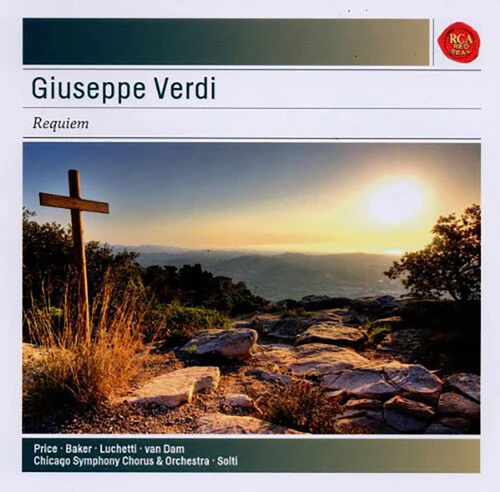
Verdi: Requiem / Price, Baker, Luchetti, van Dam, Solti, Chicago Symphony
Verdi: Requiem / Price, Baker, Luchetti, van Dam, Solti, Chicago Symphony
Of Georg Solti’s two recordings of the Verdi Requiem, I slightly prefer this later one, though I realize that this isn’t received wisdom. The Decca recording, after all, features Sutherland, Horne, Pavarotti, and Talvela as soloists, and while Sutherland arguably is not the right voice for the part, everyone else is very good indeed. On the other hand, Leontyne Price, even toward the end of her career, certainly does have the right voice, as does Veriano Luchetti, while Baker and Van Dam are very intelligent singers by any measure, and they do a good job here. Besides, it’s hard not to raise an eyebrow at the generic complaint that “singer X lacks a true Italianate timbre” when the words being sung are in Latin and the drama (such as it is) occurs entirely within a devotional framework. The music certainly can take many different approaches, particularly when there’s so little actual agreement on what a “true Italianate timbre” is.
Also compared to the Decca recording, Solti here has the finer chorus, a better orchestra (for this work at least), and strangely enough, better (meaning less gimmicky) sound. Solti’s interpretation remains consistent, exciting, and direct, with a particularly thrilling account of the brief Sanctus and a Dies Irae chorus that is as violent as anyone could want without ever turning merely brutal or hysterical. A work as rich as this one always excites a wide range of opinions, and personal preferences tend to vary substantially. My personal favorite, all things considered, is the first Muti on EMI, with Scotto, Baltsa, Luchetti, Nesterenko, and the Philharmonia Orchestra; but either of Solti’s recordings are definitely among the select few. [12/17/2004]
– Classics Today (David Hurwitz)
Also compared to the Decca recording, Solti here has the finer chorus, a better orchestra (for this work at least), and strangely enough, better (meaning less gimmicky) sound. Solti’s interpretation remains consistent, exciting, and direct, with a particularly thrilling account of the brief Sanctus and a Dies Irae chorus that is as violent as anyone could want without ever turning merely brutal or hysterical. A work as rich as this one always excites a wide range of opinions, and personal preferences tend to vary substantially. My personal favorite, all things considered, is the first Muti on EMI, with Scotto, Baltsa, Luchetti, Nesterenko, and the Philharmonia Orchestra; but either of Solti’s recordings are definitely among the select few. [12/17/2004]
– Classics Today (David Hurwitz)
$11.99
Verdi: Requiem / Price, Baker, Luchetti, van Dam, Solti, Chicago Symphony—
$11.99
Product Information
Product Information
Shipping & Returns
Shipping & Returns
Description
Of Georg Solti’s two recordings of the Verdi Requiem, I slightly prefer this later one, though I realize that this isn’t received wisdom. The Decca recording, after all, features Sutherland, Horne, Pavarotti, and Talvela as soloists, and while Sutherland arguably is not the right voice for the part, everyone else is very good indeed. On the other hand, Leontyne Price, even toward the end of her career, certainly does have the right voice, as does Veriano Luchetti, while Baker and Van Dam are very intelligent singers by any measure, and they do a good job here. Besides, it’s hard not to raise an eyebrow at the generic complaint that “singer X lacks a true Italianate timbre” when the words being sung are in Latin and the drama (such as it is) occurs entirely within a devotional framework. The music certainly can take many different approaches, particularly when there’s so little actual agreement on what a “true Italianate timbre” is.
Also compared to the Decca recording, Solti here has the finer chorus, a better orchestra (for this work at least), and strangely enough, better (meaning less gimmicky) sound. Solti’s interpretation remains consistent, exciting, and direct, with a particularly thrilling account of the brief Sanctus and a Dies Irae chorus that is as violent as anyone could want without ever turning merely brutal or hysterical. A work as rich as this one always excites a wide range of opinions, and personal preferences tend to vary substantially. My personal favorite, all things considered, is the first Muti on EMI, with Scotto, Baltsa, Luchetti, Nesterenko, and the Philharmonia Orchestra; but either of Solti’s recordings are definitely among the select few. [12/17/2004]
– Classics Today (David Hurwitz)
Also compared to the Decca recording, Solti here has the finer chorus, a better orchestra (for this work at least), and strangely enough, better (meaning less gimmicky) sound. Solti’s interpretation remains consistent, exciting, and direct, with a particularly thrilling account of the brief Sanctus and a Dies Irae chorus that is as violent as anyone could want without ever turning merely brutal or hysterical. A work as rich as this one always excites a wide range of opinions, and personal preferences tend to vary substantially. My personal favorite, all things considered, is the first Muti on EMI, with Scotto, Baltsa, Luchetti, Nesterenko, and the Philharmonia Orchestra; but either of Solti’s recordings are definitely among the select few. [12/17/2004]
– Classics Today (David Hurwitz)