🚚 Free Worldwide Shipping on All Orders!Shop Now
Tchaikovsky: Manfred Symphony, The Voyevoda / Petrenko
TCHAIKOVSKY Manfred Symphony. The Voyevoda • Vasily Petrenko, cond; Royal Liverpool PO • NAXOS 8.570568 (68:51)
This latest entry to Naxos’s Tchaikovsky series introduces the young and extraordinarily gifted conductor Vasily Petrenko (b. 1971), whose only previous exposure on discs seems to be a performance of Prokofiev’s The Gamblers (Avie), highlights from Tchaikovsky ballets (Avie), and the two Liszt piano concertos and Totentanz (Naxos). Remember you heard it here first: this is a conductor of the very first rank. In another world, with the right publicity behind him, he would be another Karajan or Markevitch. He would sell records.
I’ve been a fan of Tchaikovsky’s Manfred for decades, having first heard the recording by Toscanini. At the time I wasn’t aware that, for reasons known only to himself, he made numerous little one- and two-bar paper cuts in the first three movements, then excised a whopping 118 bars from the last movement, but I quickly discovered this when I heard the original recording by Fabian Sevitzky and the Indianapolis Symphony (Victor, 1942). I’ve also heard the recordings of Mariss Janssons, Andrew Litton, Riccardo Muti, Mikhail Pletnev, Michael Tilson Thomas, Constantin Silvestri, and Paul Kletzki. I never heard Raymond Leppard’s recording, but I heard Leppard conduct it in person with the Cincinnati Symphony many years ago. It is etched in my mind as one of the finest, most lyrical versions I’ve ever heard, much like a performance of Guido Cantelli (I told Leppard as much; he admitted that as a young musician working in England, Cantelli’s work with the Philharmonia Orchestra subconsciously influenced him a great deal).
Yet all of these performances, even Toscanini’s (ignoring his cuts in the score), tended to let me down in an overall assessment of the work. The only one I currently own is the Muti, so I will make a direct comparison of him to Petrenko. Muti is actually quite good for a non-Russian; he follows the score tempos and most (but not all) of the phrase markings closely. But, like all the conductors whose versions I’ve heard, even the Russian Pletnev (who is, in my view, vastly underrated), there is an essential life-force, you might say a “soul of Russia” feeling, missing from their recordings.
You can hear it in the way Petrenko conducts the very first movement, taken at quarter note = 66 rather than the score tempo of quarter note = 60. This may seem a radical shift, but in practice it’s not so great. The principal reason why the music sounds much faster is that Petrenko keeps nudging the beat forward, even in the Lento lugubre section, as well as strictly observing—as even Toscanini did not—the phrase marks that are clearly meant to bind the phrases together. This even extends to the dragging notes in the lower strings (violas, cellos, and basses) where Tchaikovsky very clearly marked these notes with long accents (>) rather than alla breve markings (^), which is how they are normally phrased. In addition, he moves the music forward even after pauses that follow agitated passages and introduce more lyrical ones. In this way, he creates a sound picture in the manner of such great Russian conductors as Markevitch, Coates, Svetlanov, Temirkanov, and Gergiev, a style that combined forward propulsion and subtle rubato with a peculiarly Russian string tone, warm yet edgy. In Petrenko’s hands, the Royal Liverpool Philharmonic suddenly becomes, by a startling form of alchemy, the Moscow State Orchestra. This performance doesn’t just speak Tchaikovsky; it speaks Russian, with all its visceral earthiness and thick consonants. The soul of Tchaikovsky is laid totally bare. We are deep in his subconscious.
Yet another example of this is the way he conducts the second movement. Here he is not as fast as many conductors, certainly slower than Muti; but whereas Muti conducts in a rather choppy Italianate fashion, Petrenko phrases in a legato fashion, even when scrupulously observing the staccato markings in the flute and piccolo passages. The result, if one does an A-B comparison, is that Petrenko actually sounds faster than Muti, even though his tempo is more relaxed, taken at the score tempo of quarter-note = 120, while Muti cranks it up two notches to 132. His third movement is very Svetlanov-like, an Andante with plenty of con moto , and his last movement is the most fiery I’ve heard since Sevitzky’s original 1942 recording. (The rest of Sevitzky’s reading was rather static to my ears, but in the last movement he is even more exciting than Toscanini is, and he does not chop out 118 bars as the Italian maestro did.)
There are a few other recordings of the tone poem Voyevoda available (10, to be precise), including good ones by Claudio Abbado (who “speaks” Russian pretty well for an Italian), Antal Dorati, Markevitch, and Leonard Slatkin (Russian by heritage). Petrenko pushes them all into oblivion. This Voyevoda is musically erudite, to be sure, but it also displays almost the same passion and intensity as Pique Dame or this version of Manfred.
If you’re a fan of Manfred, you simply cannot pass this disc up. If you’ve never been a fan of Manfred, you must hear this performance before you make your final decision on the work.
FANFARE: Lynn René Bayley
Product Information
Product Information
Shipping & Returns
Shipping & Returns
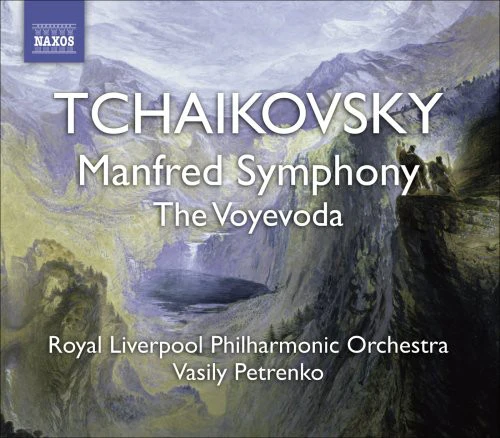

Tchaikovsky: Manfred Symphony, The Voyevoda / Petrenko
Tchaikovsky: Manfred Symphony, The Voyevoda / Petrenko
TCHAIKOVSKY Manfred Symphony. The Voyevoda • Vasily Petrenko, cond; Royal Liverpool PO • NAXOS 8.570568 (68:51)
This latest entry to Naxos’s Tchaikovsky series introduces the young and extraordinarily gifted conductor Vasily Petrenko (b. 1971), whose only previous exposure on discs seems to be a performance of Prokofiev’s The Gamblers (Avie), highlights from Tchaikovsky ballets (Avie), and the two Liszt piano concertos and Totentanz (Naxos). Remember you heard it here first: this is a conductor of the very first rank. In another world, with the right publicity behind him, he would be another Karajan or Markevitch. He would sell records.
I’ve been a fan of Tchaikovsky’s Manfred for decades, having first heard the recording by Toscanini. At the time I wasn’t aware that, for reasons known only to himself, he made numerous little one- and two-bar paper cuts in the first three movements, then excised a whopping 118 bars from the last movement, but I quickly discovered this when I heard the original recording by Fabian Sevitzky and the Indianapolis Symphony (Victor, 1942). I’ve also heard the recordings of Mariss Janssons, Andrew Litton, Riccardo Muti, Mikhail Pletnev, Michael Tilson Thomas, Constantin Silvestri, and Paul Kletzki. I never heard Raymond Leppard’s recording, but I heard Leppard conduct it in person with the Cincinnati Symphony many years ago. It is etched in my mind as one of the finest, most lyrical versions I’ve ever heard, much like a performance of Guido Cantelli (I told Leppard as much; he admitted that as a young musician working in England, Cantelli’s work with the Philharmonia Orchestra subconsciously influenced him a great deal).
Yet all of these performances, even Toscanini’s (ignoring his cuts in the score), tended to let me down in an overall assessment of the work. The only one I currently own is the Muti, so I will make a direct comparison of him to Petrenko. Muti is actually quite good for a non-Russian; he follows the score tempos and most (but not all) of the phrase markings closely. But, like all the conductors whose versions I’ve heard, even the Russian Pletnev (who is, in my view, vastly underrated), there is an essential life-force, you might say a “soul of Russia” feeling, missing from their recordings.
You can hear it in the way Petrenko conducts the very first movement, taken at quarter note = 66 rather than the score tempo of quarter note = 60. This may seem a radical shift, but in practice it’s not so great. The principal reason why the music sounds much faster is that Petrenko keeps nudging the beat forward, even in the Lento lugubre section, as well as strictly observing—as even Toscanini did not—the phrase marks that are clearly meant to bind the phrases together. This even extends to the dragging notes in the lower strings (violas, cellos, and basses) where Tchaikovsky very clearly marked these notes with long accents (>) rather than alla breve markings (^), which is how they are normally phrased. In addition, he moves the music forward even after pauses that follow agitated passages and introduce more lyrical ones. In this way, he creates a sound picture in the manner of such great Russian conductors as Markevitch, Coates, Svetlanov, Temirkanov, and Gergiev, a style that combined forward propulsion and subtle rubato with a peculiarly Russian string tone, warm yet edgy. In Petrenko’s hands, the Royal Liverpool Philharmonic suddenly becomes, by a startling form of alchemy, the Moscow State Orchestra. This performance doesn’t just speak Tchaikovsky; it speaks Russian, with all its visceral earthiness and thick consonants. The soul of Tchaikovsky is laid totally bare. We are deep in his subconscious.
Yet another example of this is the way he conducts the second movement. Here he is not as fast as many conductors, certainly slower than Muti; but whereas Muti conducts in a rather choppy Italianate fashion, Petrenko phrases in a legato fashion, even when scrupulously observing the staccato markings in the flute and piccolo passages. The result, if one does an A-B comparison, is that Petrenko actually sounds faster than Muti, even though his tempo is more relaxed, taken at the score tempo of quarter-note = 120, while Muti cranks it up two notches to 132. His third movement is very Svetlanov-like, an Andante with plenty of con moto , and his last movement is the most fiery I’ve heard since Sevitzky’s original 1942 recording. (The rest of Sevitzky’s reading was rather static to my ears, but in the last movement he is even more exciting than Toscanini is, and he does not chop out 118 bars as the Italian maestro did.)
There are a few other recordings of the tone poem Voyevoda available (10, to be precise), including good ones by Claudio Abbado (who “speaks” Russian pretty well for an Italian), Antal Dorati, Markevitch, and Leonard Slatkin (Russian by heritage). Petrenko pushes them all into oblivion. This Voyevoda is musically erudite, to be sure, but it also displays almost the same passion and intensity as Pique Dame or this version of Manfred.
If you’re a fan of Manfred, you simply cannot pass this disc up. If you’ve never been a fan of Manfred, you must hear this performance before you make your final decision on the work.
FANFARE: Lynn René Bayley
$7.00
Original: $19.99
-65%Tchaikovsky: Manfred Symphony, The Voyevoda / Petrenko—
$19.99
$7.00Product Information
Product Information
Shipping & Returns
Shipping & Returns
Description
TCHAIKOVSKY Manfred Symphony. The Voyevoda • Vasily Petrenko, cond; Royal Liverpool PO • NAXOS 8.570568 (68:51)
This latest entry to Naxos’s Tchaikovsky series introduces the young and extraordinarily gifted conductor Vasily Petrenko (b. 1971), whose only previous exposure on discs seems to be a performance of Prokofiev’s The Gamblers (Avie), highlights from Tchaikovsky ballets (Avie), and the two Liszt piano concertos and Totentanz (Naxos). Remember you heard it here first: this is a conductor of the very first rank. In another world, with the right publicity behind him, he would be another Karajan or Markevitch. He would sell records.
I’ve been a fan of Tchaikovsky’s Manfred for decades, having first heard the recording by Toscanini. At the time I wasn’t aware that, for reasons known only to himself, he made numerous little one- and two-bar paper cuts in the first three movements, then excised a whopping 118 bars from the last movement, but I quickly discovered this when I heard the original recording by Fabian Sevitzky and the Indianapolis Symphony (Victor, 1942). I’ve also heard the recordings of Mariss Janssons, Andrew Litton, Riccardo Muti, Mikhail Pletnev, Michael Tilson Thomas, Constantin Silvestri, and Paul Kletzki. I never heard Raymond Leppard’s recording, but I heard Leppard conduct it in person with the Cincinnati Symphony many years ago. It is etched in my mind as one of the finest, most lyrical versions I’ve ever heard, much like a performance of Guido Cantelli (I told Leppard as much; he admitted that as a young musician working in England, Cantelli’s work with the Philharmonia Orchestra subconsciously influenced him a great deal).
Yet all of these performances, even Toscanini’s (ignoring his cuts in the score), tended to let me down in an overall assessment of the work. The only one I currently own is the Muti, so I will make a direct comparison of him to Petrenko. Muti is actually quite good for a non-Russian; he follows the score tempos and most (but not all) of the phrase markings closely. But, like all the conductors whose versions I’ve heard, even the Russian Pletnev (who is, in my view, vastly underrated), there is an essential life-force, you might say a “soul of Russia” feeling, missing from their recordings.
You can hear it in the way Petrenko conducts the very first movement, taken at quarter note = 66 rather than the score tempo of quarter note = 60. This may seem a radical shift, but in practice it’s not so great. The principal reason why the music sounds much faster is that Petrenko keeps nudging the beat forward, even in the Lento lugubre section, as well as strictly observing—as even Toscanini did not—the phrase marks that are clearly meant to bind the phrases together. This even extends to the dragging notes in the lower strings (violas, cellos, and basses) where Tchaikovsky very clearly marked these notes with long accents (>) rather than alla breve markings (^), which is how they are normally phrased. In addition, he moves the music forward even after pauses that follow agitated passages and introduce more lyrical ones. In this way, he creates a sound picture in the manner of such great Russian conductors as Markevitch, Coates, Svetlanov, Temirkanov, and Gergiev, a style that combined forward propulsion and subtle rubato with a peculiarly Russian string tone, warm yet edgy. In Petrenko’s hands, the Royal Liverpool Philharmonic suddenly becomes, by a startling form of alchemy, the Moscow State Orchestra. This performance doesn’t just speak Tchaikovsky; it speaks Russian, with all its visceral earthiness and thick consonants. The soul of Tchaikovsky is laid totally bare. We are deep in his subconscious.
Yet another example of this is the way he conducts the second movement. Here he is not as fast as many conductors, certainly slower than Muti; but whereas Muti conducts in a rather choppy Italianate fashion, Petrenko phrases in a legato fashion, even when scrupulously observing the staccato markings in the flute and piccolo passages. The result, if one does an A-B comparison, is that Petrenko actually sounds faster than Muti, even though his tempo is more relaxed, taken at the score tempo of quarter-note = 120, while Muti cranks it up two notches to 132. His third movement is very Svetlanov-like, an Andante with plenty of con moto , and his last movement is the most fiery I’ve heard since Sevitzky’s original 1942 recording. (The rest of Sevitzky’s reading was rather static to my ears, but in the last movement he is even more exciting than Toscanini is, and he does not chop out 118 bars as the Italian maestro did.)
There are a few other recordings of the tone poem Voyevoda available (10, to be precise), including good ones by Claudio Abbado (who “speaks” Russian pretty well for an Italian), Antal Dorati, Markevitch, and Leonard Slatkin (Russian by heritage). Petrenko pushes them all into oblivion. This Voyevoda is musically erudite, to be sure, but it also displays almost the same passion and intensity as Pique Dame or this version of Manfred.
If you’re a fan of Manfred, you simply cannot pass this disc up. If you’ve never been a fan of Manfred, you must hear this performance before you make your final decision on the work.
FANFARE: Lynn René Bayley