🚚 Free Worldwide Shipping on All Orders!Shop Now
Rheinberger: Works For Violin And Organ / Most, Ziener
"At his best, Rheinberger offers a surprising and often telling synthesis of Baroque counterpoint with a gently Romantic sensibility. One could say the same of Anton Bruckner, but, unlike Bruckner, there is no compelling forward thrust in this music—nothing heaven storming, or, unlike Beethoven, nothing that pushes the technical or aesthetic envelope. Rheinberger was content to use the musical language he inherited from his teachers, the organist Johann Georg Herzog and the composer Ferdinand Lachner, who was one of Schubert’s devotees. Joseph Gabriel Rheinberger (1839–1901) was born in Vaduz, the capital of Liechtenstein. A child prodigy organist, he was appointed, at age seven, to the post of town organist. Subsequent training in organ and composition took him to Munich and, ultimately, to Vienna where he lived out his days as a composer of 197 works—including symphonies, tone poems, chamber works, piano pieces, masses, requiems, and two operas—and as a teacher at the Vienna Conservatory. Among his pupils can be counted Engelbert Humperdinck, Ermanno Wolf-Ferrari, and Horatio Parker. The Lachner connection is intriguing, in that Rheinberger’s life span effectively brought the world of Schubert into the first year of the 20th century. Seen in a different light, Rheinberger was a hopeless anachronism. Listening to this music, I wonder how he must have reacted to the “music of the future,” as exemplified in Wagner’s tonally ambivalent Tristan.
There is a good deal of Biedermeier charm in these two works, but that is only one of its constituent elements. At its core, it is made of sterner stuff. The Six Pieces for Violin and Organ, op. 150, masquerades as a Baroque suite. Its opening movement is a stylized French overture, which provides one of the piece’s finest moments, in Rheinberger’s aforementioned synthesis of Baroque and Romantic languages. Unlike how they would have been handled by the great Baroque masters, the following movements—Pastorale, Gigue, Elegie, Abendlied, and Theme and Variations—the liner notes claim, “do not have any real interconnection, either thematically or with regard to key.” The implication is that we have a handful of pretty genre pieces and not much more. I respectfully disagree. There are subtle thematic and harmonic links throughout these pieces, and some of them—the Pastorale and especially the Elegy—are achingly beautiful in their inconsolable melancholy. The second work, Suite for Violin and Organ, op. 166, is more closely reasoned. Its opening Preludium evokes the world of Bach. The following Canzone takes us into the worlds of Schubert and Brahms, although there is also a Brucknerian quality in its austerity and in its ability to make time stand still, qualities that also characterize the following Allemande with its Brahmsian trio section. The final Moto perpetuo is based on the same harmonic progression that underpins the whole suite, and it puts the violinist to the test—one that she passes with flying colors.
Violinist Line Most’s intonation is impeccable, and her tone production is ravishing. Organist Marie Ziener, playing the fine organ of David’s Church, Copenhagen (Marcussen & Son, 1980) is with her hand-in-glove. The recorded balances in this tricky repertoire are beyond reproach."
William Zagorski, FANFARE
There is a good deal of Biedermeier charm in these two works, but that is only one of its constituent elements. At its core, it is made of sterner stuff. The Six Pieces for Violin and Organ, op. 150, masquerades as a Baroque suite. Its opening movement is a stylized French overture, which provides one of the piece’s finest moments, in Rheinberger’s aforementioned synthesis of Baroque and Romantic languages. Unlike how they would have been handled by the great Baroque masters, the following movements—Pastorale, Gigue, Elegie, Abendlied, and Theme and Variations—the liner notes claim, “do not have any real interconnection, either thematically or with regard to key.” The implication is that we have a handful of pretty genre pieces and not much more. I respectfully disagree. There are subtle thematic and harmonic links throughout these pieces, and some of them—the Pastorale and especially the Elegy—are achingly beautiful in their inconsolable melancholy. The second work, Suite for Violin and Organ, op. 166, is more closely reasoned. Its opening Preludium evokes the world of Bach. The following Canzone takes us into the worlds of Schubert and Brahms, although there is also a Brucknerian quality in its austerity and in its ability to make time stand still, qualities that also characterize the following Allemande with its Brahmsian trio section. The final Moto perpetuo is based on the same harmonic progression that underpins the whole suite, and it puts the violinist to the test—one that she passes with flying colors.
Violinist Line Most’s intonation is impeccable, and her tone production is ravishing. Organist Marie Ziener, playing the fine organ of David’s Church, Copenhagen (Marcussen & Son, 1980) is with her hand-in-glove. The recorded balances in this tricky repertoire are beyond reproach."
William Zagorski, FANFARE
Product Information
Product Information
Shipping & Returns
Shipping & Returns
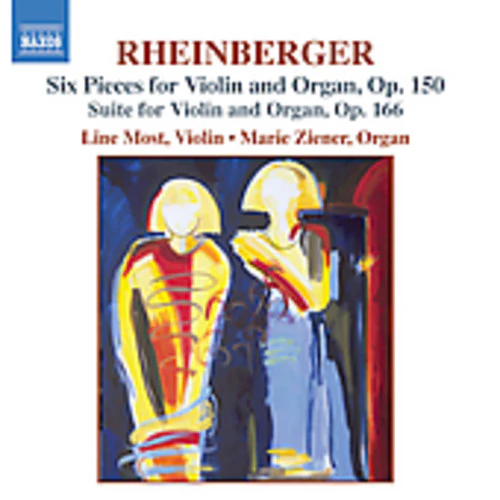

Rheinberger: Works For Violin And Organ / Most, Ziener
Rheinberger: Works For Violin And Organ / Most, Ziener
"At his best, Rheinberger offers a surprising and often telling synthesis of Baroque counterpoint with a gently Romantic sensibility. One could say the same of Anton Bruckner, but, unlike Bruckner, there is no compelling forward thrust in this music—nothing heaven storming, or, unlike Beethoven, nothing that pushes the technical or aesthetic envelope. Rheinberger was content to use the musical language he inherited from his teachers, the organist Johann Georg Herzog and the composer Ferdinand Lachner, who was one of Schubert’s devotees. Joseph Gabriel Rheinberger (1839–1901) was born in Vaduz, the capital of Liechtenstein. A child prodigy organist, he was appointed, at age seven, to the post of town organist. Subsequent training in organ and composition took him to Munich and, ultimately, to Vienna where he lived out his days as a composer of 197 works—including symphonies, tone poems, chamber works, piano pieces, masses, requiems, and two operas—and as a teacher at the Vienna Conservatory. Among his pupils can be counted Engelbert Humperdinck, Ermanno Wolf-Ferrari, and Horatio Parker. The Lachner connection is intriguing, in that Rheinberger’s life span effectively brought the world of Schubert into the first year of the 20th century. Seen in a different light, Rheinberger was a hopeless anachronism. Listening to this music, I wonder how he must have reacted to the “music of the future,” as exemplified in Wagner’s tonally ambivalent Tristan.
There is a good deal of Biedermeier charm in these two works, but that is only one of its constituent elements. At its core, it is made of sterner stuff. The Six Pieces for Violin and Organ, op. 150, masquerades as a Baroque suite. Its opening movement is a stylized French overture, which provides one of the piece’s finest moments, in Rheinberger’s aforementioned synthesis of Baroque and Romantic languages. Unlike how they would have been handled by the great Baroque masters, the following movements—Pastorale, Gigue, Elegie, Abendlied, and Theme and Variations—the liner notes claim, “do not have any real interconnection, either thematically or with regard to key.” The implication is that we have a handful of pretty genre pieces and not much more. I respectfully disagree. There are subtle thematic and harmonic links throughout these pieces, and some of them—the Pastorale and especially the Elegy—are achingly beautiful in their inconsolable melancholy. The second work, Suite for Violin and Organ, op. 166, is more closely reasoned. Its opening Preludium evokes the world of Bach. The following Canzone takes us into the worlds of Schubert and Brahms, although there is also a Brucknerian quality in its austerity and in its ability to make time stand still, qualities that also characterize the following Allemande with its Brahmsian trio section. The final Moto perpetuo is based on the same harmonic progression that underpins the whole suite, and it puts the violinist to the test—one that she passes with flying colors.
Violinist Line Most’s intonation is impeccable, and her tone production is ravishing. Organist Marie Ziener, playing the fine organ of David’s Church, Copenhagen (Marcussen & Son, 1980) is with her hand-in-glove. The recorded balances in this tricky repertoire are beyond reproach."
William Zagorski, FANFARE
There is a good deal of Biedermeier charm in these two works, but that is only one of its constituent elements. At its core, it is made of sterner stuff. The Six Pieces for Violin and Organ, op. 150, masquerades as a Baroque suite. Its opening movement is a stylized French overture, which provides one of the piece’s finest moments, in Rheinberger’s aforementioned synthesis of Baroque and Romantic languages. Unlike how they would have been handled by the great Baroque masters, the following movements—Pastorale, Gigue, Elegie, Abendlied, and Theme and Variations—the liner notes claim, “do not have any real interconnection, either thematically or with regard to key.” The implication is that we have a handful of pretty genre pieces and not much more. I respectfully disagree. There are subtle thematic and harmonic links throughout these pieces, and some of them—the Pastorale and especially the Elegy—are achingly beautiful in their inconsolable melancholy. The second work, Suite for Violin and Organ, op. 166, is more closely reasoned. Its opening Preludium evokes the world of Bach. The following Canzone takes us into the worlds of Schubert and Brahms, although there is also a Brucknerian quality in its austerity and in its ability to make time stand still, qualities that also characterize the following Allemande with its Brahmsian trio section. The final Moto perpetuo is based on the same harmonic progression that underpins the whole suite, and it puts the violinist to the test—one that she passes with flying colors.
Violinist Line Most’s intonation is impeccable, and her tone production is ravishing. Organist Marie Ziener, playing the fine organ of David’s Church, Copenhagen (Marcussen & Son, 1980) is with her hand-in-glove. The recorded balances in this tricky repertoire are beyond reproach."
William Zagorski, FANFARE
$13.99
Rheinberger: Works For Violin And Organ / Most, Ziener—
$13.99
Product Information
Product Information
Shipping & Returns
Shipping & Returns
Description
"At his best, Rheinberger offers a surprising and often telling synthesis of Baroque counterpoint with a gently Romantic sensibility. One could say the same of Anton Bruckner, but, unlike Bruckner, there is no compelling forward thrust in this music—nothing heaven storming, or, unlike Beethoven, nothing that pushes the technical or aesthetic envelope. Rheinberger was content to use the musical language he inherited from his teachers, the organist Johann Georg Herzog and the composer Ferdinand Lachner, who was one of Schubert’s devotees. Joseph Gabriel Rheinberger (1839–1901) was born in Vaduz, the capital of Liechtenstein. A child prodigy organist, he was appointed, at age seven, to the post of town organist. Subsequent training in organ and composition took him to Munich and, ultimately, to Vienna where he lived out his days as a composer of 197 works—including symphonies, tone poems, chamber works, piano pieces, masses, requiems, and two operas—and as a teacher at the Vienna Conservatory. Among his pupils can be counted Engelbert Humperdinck, Ermanno Wolf-Ferrari, and Horatio Parker. The Lachner connection is intriguing, in that Rheinberger’s life span effectively brought the world of Schubert into the first year of the 20th century. Seen in a different light, Rheinberger was a hopeless anachronism. Listening to this music, I wonder how he must have reacted to the “music of the future,” as exemplified in Wagner’s tonally ambivalent Tristan.
There is a good deal of Biedermeier charm in these two works, but that is only one of its constituent elements. At its core, it is made of sterner stuff. The Six Pieces for Violin and Organ, op. 150, masquerades as a Baroque suite. Its opening movement is a stylized French overture, which provides one of the piece’s finest moments, in Rheinberger’s aforementioned synthesis of Baroque and Romantic languages. Unlike how they would have been handled by the great Baroque masters, the following movements—Pastorale, Gigue, Elegie, Abendlied, and Theme and Variations—the liner notes claim, “do not have any real interconnection, either thematically or with regard to key.” The implication is that we have a handful of pretty genre pieces and not much more. I respectfully disagree. There are subtle thematic and harmonic links throughout these pieces, and some of them—the Pastorale and especially the Elegy—are achingly beautiful in their inconsolable melancholy. The second work, Suite for Violin and Organ, op. 166, is more closely reasoned. Its opening Preludium evokes the world of Bach. The following Canzone takes us into the worlds of Schubert and Brahms, although there is also a Brucknerian quality in its austerity and in its ability to make time stand still, qualities that also characterize the following Allemande with its Brahmsian trio section. The final Moto perpetuo is based on the same harmonic progression that underpins the whole suite, and it puts the violinist to the test—one that she passes with flying colors.
Violinist Line Most’s intonation is impeccable, and her tone production is ravishing. Organist Marie Ziener, playing the fine organ of David’s Church, Copenhagen (Marcussen & Son, 1980) is with her hand-in-glove. The recorded balances in this tricky repertoire are beyond reproach."
William Zagorski, FANFARE
There is a good deal of Biedermeier charm in these two works, but that is only one of its constituent elements. At its core, it is made of sterner stuff. The Six Pieces for Violin and Organ, op. 150, masquerades as a Baroque suite. Its opening movement is a stylized French overture, which provides one of the piece’s finest moments, in Rheinberger’s aforementioned synthesis of Baroque and Romantic languages. Unlike how they would have been handled by the great Baroque masters, the following movements—Pastorale, Gigue, Elegie, Abendlied, and Theme and Variations—the liner notes claim, “do not have any real interconnection, either thematically or with regard to key.” The implication is that we have a handful of pretty genre pieces and not much more. I respectfully disagree. There are subtle thematic and harmonic links throughout these pieces, and some of them—the Pastorale and especially the Elegy—are achingly beautiful in their inconsolable melancholy. The second work, Suite for Violin and Organ, op. 166, is more closely reasoned. Its opening Preludium evokes the world of Bach. The following Canzone takes us into the worlds of Schubert and Brahms, although there is also a Brucknerian quality in its austerity and in its ability to make time stand still, qualities that also characterize the following Allemande with its Brahmsian trio section. The final Moto perpetuo is based on the same harmonic progression that underpins the whole suite, and it puts the violinist to the test—one that she passes with flying colors.
Violinist Line Most’s intonation is impeccable, and her tone production is ravishing. Organist Marie Ziener, playing the fine organ of David’s Church, Copenhagen (Marcussen & Son, 1980) is with her hand-in-glove. The recorded balances in this tricky repertoire are beyond reproach."
William Zagorski, FANFARE