🚚 Free Worldwide Shipping on All Orders!Shop Now
Nuits / Veronique Gens, I Giardini
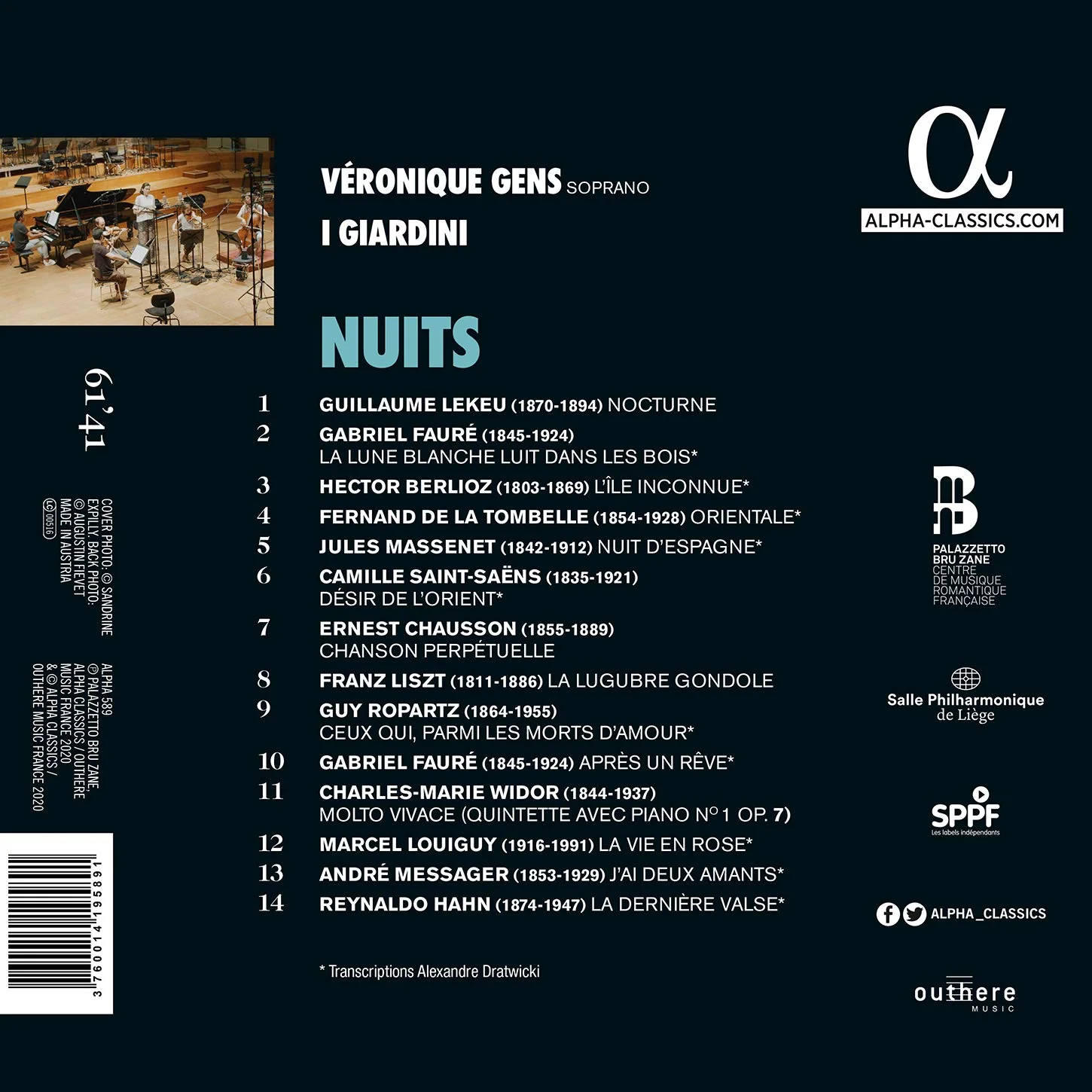
As the symbiosis between the art of the poet and that of the composer, the French melodie became the jewel of the salons of the ‘Belle epoque’. By placing a string quartet and a piano around the singer, Chausson’s Chanson perpetuelle, Lekeu’s Nocturne and Faure’s La Bonne Chanson oscillate between chamber musical intimacy and orchestral ambition. Alongside these famous pioneering pieces, this programme devised by the Palazzetto Bru Zane champions a return to the art of transcription, so popular in the nineteenth century, with the aim of expanding the repertory for voice, strings and piano in order to unearth some forgotten treasures. Hence Hahn, Berlioz, Saint-Saens, Massenet, La Tombelle, Ropartz, Louiguy and Messager all appear in a programme whose guiding thread is the emotions of nocturnal abandonment: the charms of twilight, the trajectory of dreams, the terror of nightmare or the exhilaration of festive occasions. Alexandre Dratwicki has made these arrangements in the style of the nineteenth century. Appropriately enough, the programme ends with La Vie en rose, for this music offers a kaleidoscope of all the colors of human feeling. The texture of solo strings and piano sets Veronique Gens’s incomparable storytelling artistry in a new light.
-----
REVIEWS:
Soprano Véronique Gens’ last four solo albums have been for the Alpha Classics label, a collaboration which is undoubtedly bearing luscious fruit. Now with ‘Nuits’ (Nights), her new album for Alpha, Gens revisits the genre of French mélodies. Here the fourteen-work programme focuses on eleven mélodies for voice with piano and string quartet accompaniment, played by chamber ensemble I Giardini. Three mélodies have been written by the respective composers’ own hands and eight are transcriptions prepared by Alexandre Dratwicki (Palazzetto Bru Zane). Serving as interludes, the three remaining works are purely instrumental works by Liszt, La Tombelle and Widor. Essentially, the programme is designed not only to suit the qualities of Gen’s voice but to widen the mélodie repertoire with voice accompanied by chamber forces and to present well-known examples together with some rarely heard.
Created by Bru Zane, Gen’s programme has at its cornerstone the theme of ‘Nuits’ (Nights) exploring the different ways poets have described nightfall and dreams. The eleven mélodies have been categorised under four descriptive French headings which Dratwicki helpfully describes as ‘the charms of twilight’ (Lekeu, Fauré, Berlioz); ‘the path of dreams’ (Massenet, Saint-Saëns); the terror of nightmares’ (Chausson, Ropartz, Fauré) and ‘the dizziness of rejoicing’ (Louiguy/Piaf, Messager, Hahn).
Singing in her native French, Orléans-born Gens demonstrates compelling form in such frequently beguiling repertoire. Given her impeccable diction, one feels that the soprano is affording each word of the mélodie special attention. Standing out, too, are Gens’ steadfast vocal lines and purity of tone, enriched by her instinctive talent for style, composure and sincerity.
New to me is Ropartz’s exquisite Ceux qui, parmi les morts d’amour (Those who Died from Love). This is Ropartz’s setting of his own French translation prepared in collaboration with Pierre-René Hirsch after Heinrich Heine’s original German text. There is an affecting sincerity as Gens expresses the lovesick protagonist identifying with the ultimate price paid by suicide victims. Memorable, too, is Après un rêve (After a Dream) Faure’s setting of a Romain Bussine poem. Gens provides a satisfying generosity of expression in this exquisite mélodie, a portrayal infused with tenderness. By some distance, the best-known work on this collection is La Vie en rose with a melody by Louis Guglielmi (Louiguy) to a text by legendary French singer Édith Piaf who made the song world-famous. Clearly enjoying it, Gens sings admirably but I find hers and the other cover versions unable to match the individuality of Piaf’s own recordings and her unique relationship to her signature song.
Gens is deftly accompanied by I Giardini, a chamber ensemble founded in 2012 by Pauline Buet (cello) and David Violi (piano) its joint artistic directors. Set up here as a string quartet with piano, I Giardini is impressive with its sparkling contribution, communicating compassion when needed. Violi’s playing on a lovely toned Steinway is striking throughout and in Liszt’s La Lugubre Gondole (The Funeral Gondola) Buet excels, displays a wistful, yet delightful, cello line.
Sound engineer Olivier Rosset achieves satisfying a quality, with clarity and impressive balance. Alpha Classics is to be commended for ensuring that the French sung texts with English translations are provided in the booklet. There are a couple of helpful essays too: ‘Four Variations of the Soul’ written by Alexandre Dratwicki and the other ‘Love of the Night, Love of the Exotic’ by Hélène Cao.
This new album makes a captivating prospect and one difficult to ignore.
– MusicWeb International (Michael Cookson)
It is hard to imagine a voice better suited to this repertoire. Evenness of tone between registers and seamless legato are as apparent as ever, as is careful attention to diction and a sensitivity to the changing sentiments of the poetry. Full texts and translations are provided. This is a first-class production in every way and should be heard by every lover of the French mélodie.
– The Classic Review
-----
REVIEWS:
Soprano Véronique Gens’ last four solo albums have been for the Alpha Classics label, a collaboration which is undoubtedly bearing luscious fruit. Now with ‘Nuits’ (Nights), her new album for Alpha, Gens revisits the genre of French mélodies. Here the fourteen-work programme focuses on eleven mélodies for voice with piano and string quartet accompaniment, played by chamber ensemble I Giardini. Three mélodies have been written by the respective composers’ own hands and eight are transcriptions prepared by Alexandre Dratwicki (Palazzetto Bru Zane). Serving as interludes, the three remaining works are purely instrumental works by Liszt, La Tombelle and Widor. Essentially, the programme is designed not only to suit the qualities of Gen’s voice but to widen the mélodie repertoire with voice accompanied by chamber forces and to present well-known examples together with some rarely heard.
Created by Bru Zane, Gen’s programme has at its cornerstone the theme of ‘Nuits’ (Nights) exploring the different ways poets have described nightfall and dreams. The eleven mélodies have been categorised under four descriptive French headings which Dratwicki helpfully describes as ‘the charms of twilight’ (Lekeu, Fauré, Berlioz); ‘the path of dreams’ (Massenet, Saint-Saëns); the terror of nightmares’ (Chausson, Ropartz, Fauré) and ‘the dizziness of rejoicing’ (Louiguy/Piaf, Messager, Hahn).
Singing in her native French, Orléans-born Gens demonstrates compelling form in such frequently beguiling repertoire. Given her impeccable diction, one feels that the soprano is affording each word of the mélodie special attention. Standing out, too, are Gens’ steadfast vocal lines and purity of tone, enriched by her instinctive talent for style, composure and sincerity.
New to me is Ropartz’s exquisite Ceux qui, parmi les morts d’amour (Those who Died from Love). This is Ropartz’s setting of his own French translation prepared in collaboration with Pierre-René Hirsch after Heinrich Heine’s original German text. There is an affecting sincerity as Gens expresses the lovesick protagonist identifying with the ultimate price paid by suicide victims. Memorable, too, is Après un rêve (After a Dream) Faure’s setting of a Romain Bussine poem. Gens provides a satisfying generosity of expression in this exquisite mélodie, a portrayal infused with tenderness. By some distance, the best-known work on this collection is La Vie en rose with a melody by Louis Guglielmi (Louiguy) to a text by legendary French singer Édith Piaf who made the song world-famous. Clearly enjoying it, Gens sings admirably but I find hers and the other cover versions unable to match the individuality of Piaf’s own recordings and her unique relationship to her signature song.
Gens is deftly accompanied by I Giardini, a chamber ensemble founded in 2012 by Pauline Buet (cello) and David Violi (piano) its joint artistic directors. Set up here as a string quartet with piano, I Giardini is impressive with its sparkling contribution, communicating compassion when needed. Violi’s playing on a lovely toned Steinway is striking throughout and in Liszt’s La Lugubre Gondole (The Funeral Gondola) Buet excels, displays a wistful, yet delightful, cello line.
Sound engineer Olivier Rosset achieves satisfying a quality, with clarity and impressive balance. Alpha Classics is to be commended for ensuring that the French sung texts with English translations are provided in the booklet. There are a couple of helpful essays too: ‘Four Variations of the Soul’ written by Alexandre Dratwicki and the other ‘Love of the Night, Love of the Exotic’ by Hélène Cao.
This new album makes a captivating prospect and one difficult to ignore.
– MusicWeb International (Michael Cookson)
It is hard to imagine a voice better suited to this repertoire. Evenness of tone between registers and seamless legato are as apparent as ever, as is careful attention to diction and a sensitivity to the changing sentiments of the poetry. Full texts and translations are provided. This is a first-class production in every way and should be heard by every lover of the French mélodie.
– The Classic Review
Product Information
Product Information
Shipping & Returns
Shipping & Returns

Nuits / Veronique Gens, I Giardini
Nuits / Veronique Gens, I Giardini
As the symbiosis between the art of the poet and that of the composer, the French melodie became the jewel of the salons of the ‘Belle epoque’. By placing a string quartet and a piano around the singer, Chausson’s Chanson perpetuelle, Lekeu’s Nocturne and Faure’s La Bonne Chanson oscillate between chamber musical intimacy and orchestral ambition. Alongside these famous pioneering pieces, this programme devised by the Palazzetto Bru Zane champions a return to the art of transcription, so popular in the nineteenth century, with the aim of expanding the repertory for voice, strings and piano in order to unearth some forgotten treasures. Hence Hahn, Berlioz, Saint-Saens, Massenet, La Tombelle, Ropartz, Louiguy and Messager all appear in a programme whose guiding thread is the emotions of nocturnal abandonment: the charms of twilight, the trajectory of dreams, the terror of nightmare or the exhilaration of festive occasions. Alexandre Dratwicki has made these arrangements in the style of the nineteenth century. Appropriately enough, the programme ends with La Vie en rose, for this music offers a kaleidoscope of all the colors of human feeling. The texture of solo strings and piano sets Veronique Gens’s incomparable storytelling artistry in a new light.
-----
REVIEWS:
Soprano Véronique Gens’ last four solo albums have been for the Alpha Classics label, a collaboration which is undoubtedly bearing luscious fruit. Now with ‘Nuits’ (Nights), her new album for Alpha, Gens revisits the genre of French mélodies. Here the fourteen-work programme focuses on eleven mélodies for voice with piano and string quartet accompaniment, played by chamber ensemble I Giardini. Three mélodies have been written by the respective composers’ own hands and eight are transcriptions prepared by Alexandre Dratwicki (Palazzetto Bru Zane). Serving as interludes, the three remaining works are purely instrumental works by Liszt, La Tombelle and Widor. Essentially, the programme is designed not only to suit the qualities of Gen’s voice but to widen the mélodie repertoire with voice accompanied by chamber forces and to present well-known examples together with some rarely heard.
Created by Bru Zane, Gen’s programme has at its cornerstone the theme of ‘Nuits’ (Nights) exploring the different ways poets have described nightfall and dreams. The eleven mélodies have been categorised under four descriptive French headings which Dratwicki helpfully describes as ‘the charms of twilight’ (Lekeu, Fauré, Berlioz); ‘the path of dreams’ (Massenet, Saint-Saëns); the terror of nightmares’ (Chausson, Ropartz, Fauré) and ‘the dizziness of rejoicing’ (Louiguy/Piaf, Messager, Hahn).
Singing in her native French, Orléans-born Gens demonstrates compelling form in such frequently beguiling repertoire. Given her impeccable diction, one feels that the soprano is affording each word of the mélodie special attention. Standing out, too, are Gens’ steadfast vocal lines and purity of tone, enriched by her instinctive talent for style, composure and sincerity.
New to me is Ropartz’s exquisite Ceux qui, parmi les morts d’amour (Those who Died from Love). This is Ropartz’s setting of his own French translation prepared in collaboration with Pierre-René Hirsch after Heinrich Heine’s original German text. There is an affecting sincerity as Gens expresses the lovesick protagonist identifying with the ultimate price paid by suicide victims. Memorable, too, is Après un rêve (After a Dream) Faure’s setting of a Romain Bussine poem. Gens provides a satisfying generosity of expression in this exquisite mélodie, a portrayal infused with tenderness. By some distance, the best-known work on this collection is La Vie en rose with a melody by Louis Guglielmi (Louiguy) to a text by legendary French singer Édith Piaf who made the song world-famous. Clearly enjoying it, Gens sings admirably but I find hers and the other cover versions unable to match the individuality of Piaf’s own recordings and her unique relationship to her signature song.
Gens is deftly accompanied by I Giardini, a chamber ensemble founded in 2012 by Pauline Buet (cello) and David Violi (piano) its joint artistic directors. Set up here as a string quartet with piano, I Giardini is impressive with its sparkling contribution, communicating compassion when needed. Violi’s playing on a lovely toned Steinway is striking throughout and in Liszt’s La Lugubre Gondole (The Funeral Gondola) Buet excels, displays a wistful, yet delightful, cello line.
Sound engineer Olivier Rosset achieves satisfying a quality, with clarity and impressive balance. Alpha Classics is to be commended for ensuring that the French sung texts with English translations are provided in the booklet. There are a couple of helpful essays too: ‘Four Variations of the Soul’ written by Alexandre Dratwicki and the other ‘Love of the Night, Love of the Exotic’ by Hélène Cao.
This new album makes a captivating prospect and one difficult to ignore.
– MusicWeb International (Michael Cookson)
It is hard to imagine a voice better suited to this repertoire. Evenness of tone between registers and seamless legato are as apparent as ever, as is careful attention to diction and a sensitivity to the changing sentiments of the poetry. Full texts and translations are provided. This is a first-class production in every way and should be heard by every lover of the French mélodie.
– The Classic Review
-----
REVIEWS:
Soprano Véronique Gens’ last four solo albums have been for the Alpha Classics label, a collaboration which is undoubtedly bearing luscious fruit. Now with ‘Nuits’ (Nights), her new album for Alpha, Gens revisits the genre of French mélodies. Here the fourteen-work programme focuses on eleven mélodies for voice with piano and string quartet accompaniment, played by chamber ensemble I Giardini. Three mélodies have been written by the respective composers’ own hands and eight are transcriptions prepared by Alexandre Dratwicki (Palazzetto Bru Zane). Serving as interludes, the three remaining works are purely instrumental works by Liszt, La Tombelle and Widor. Essentially, the programme is designed not only to suit the qualities of Gen’s voice but to widen the mélodie repertoire with voice accompanied by chamber forces and to present well-known examples together with some rarely heard.
Created by Bru Zane, Gen’s programme has at its cornerstone the theme of ‘Nuits’ (Nights) exploring the different ways poets have described nightfall and dreams. The eleven mélodies have been categorised under four descriptive French headings which Dratwicki helpfully describes as ‘the charms of twilight’ (Lekeu, Fauré, Berlioz); ‘the path of dreams’ (Massenet, Saint-Saëns); the terror of nightmares’ (Chausson, Ropartz, Fauré) and ‘the dizziness of rejoicing’ (Louiguy/Piaf, Messager, Hahn).
Singing in her native French, Orléans-born Gens demonstrates compelling form in such frequently beguiling repertoire. Given her impeccable diction, one feels that the soprano is affording each word of the mélodie special attention. Standing out, too, are Gens’ steadfast vocal lines and purity of tone, enriched by her instinctive talent for style, composure and sincerity.
New to me is Ropartz’s exquisite Ceux qui, parmi les morts d’amour (Those who Died from Love). This is Ropartz’s setting of his own French translation prepared in collaboration with Pierre-René Hirsch after Heinrich Heine’s original German text. There is an affecting sincerity as Gens expresses the lovesick protagonist identifying with the ultimate price paid by suicide victims. Memorable, too, is Après un rêve (After a Dream) Faure’s setting of a Romain Bussine poem. Gens provides a satisfying generosity of expression in this exquisite mélodie, a portrayal infused with tenderness. By some distance, the best-known work on this collection is La Vie en rose with a melody by Louis Guglielmi (Louiguy) to a text by legendary French singer Édith Piaf who made the song world-famous. Clearly enjoying it, Gens sings admirably but I find hers and the other cover versions unable to match the individuality of Piaf’s own recordings and her unique relationship to her signature song.
Gens is deftly accompanied by I Giardini, a chamber ensemble founded in 2012 by Pauline Buet (cello) and David Violi (piano) its joint artistic directors. Set up here as a string quartet with piano, I Giardini is impressive with its sparkling contribution, communicating compassion when needed. Violi’s playing on a lovely toned Steinway is striking throughout and in Liszt’s La Lugubre Gondole (The Funeral Gondola) Buet excels, displays a wistful, yet delightful, cello line.
Sound engineer Olivier Rosset achieves satisfying a quality, with clarity and impressive balance. Alpha Classics is to be commended for ensuring that the French sung texts with English translations are provided in the booklet. There are a couple of helpful essays too: ‘Four Variations of the Soul’ written by Alexandre Dratwicki and the other ‘Love of the Night, Love of the Exotic’ by Hélène Cao.
This new album makes a captivating prospect and one difficult to ignore.
– MusicWeb International (Michael Cookson)
It is hard to imagine a voice better suited to this repertoire. Evenness of tone between registers and seamless legato are as apparent as ever, as is careful attention to diction and a sensitivity to the changing sentiments of the poetry. Full texts and translations are provided. This is a first-class production in every way and should be heard by every lover of the French mélodie.
– The Classic Review
$20.99
Nuits / Veronique Gens, I Giardini—
$20.99
Product Information
Product Information
Shipping & Returns
Shipping & Returns
Description
As the symbiosis between the art of the poet and that of the composer, the French melodie became the jewel of the salons of the ‘Belle epoque’. By placing a string quartet and a piano around the singer, Chausson’s Chanson perpetuelle, Lekeu’s Nocturne and Faure’s La Bonne Chanson oscillate between chamber musical intimacy and orchestral ambition. Alongside these famous pioneering pieces, this programme devised by the Palazzetto Bru Zane champions a return to the art of transcription, so popular in the nineteenth century, with the aim of expanding the repertory for voice, strings and piano in order to unearth some forgotten treasures. Hence Hahn, Berlioz, Saint-Saens, Massenet, La Tombelle, Ropartz, Louiguy and Messager all appear in a programme whose guiding thread is the emotions of nocturnal abandonment: the charms of twilight, the trajectory of dreams, the terror of nightmare or the exhilaration of festive occasions. Alexandre Dratwicki has made these arrangements in the style of the nineteenth century. Appropriately enough, the programme ends with La Vie en rose, for this music offers a kaleidoscope of all the colors of human feeling. The texture of solo strings and piano sets Veronique Gens’s incomparable storytelling artistry in a new light.
-----
REVIEWS:
Soprano Véronique Gens’ last four solo albums have been for the Alpha Classics label, a collaboration which is undoubtedly bearing luscious fruit. Now with ‘Nuits’ (Nights), her new album for Alpha, Gens revisits the genre of French mélodies. Here the fourteen-work programme focuses on eleven mélodies for voice with piano and string quartet accompaniment, played by chamber ensemble I Giardini. Three mélodies have been written by the respective composers’ own hands and eight are transcriptions prepared by Alexandre Dratwicki (Palazzetto Bru Zane). Serving as interludes, the three remaining works are purely instrumental works by Liszt, La Tombelle and Widor. Essentially, the programme is designed not only to suit the qualities of Gen’s voice but to widen the mélodie repertoire with voice accompanied by chamber forces and to present well-known examples together with some rarely heard.
Created by Bru Zane, Gen’s programme has at its cornerstone the theme of ‘Nuits’ (Nights) exploring the different ways poets have described nightfall and dreams. The eleven mélodies have been categorised under four descriptive French headings which Dratwicki helpfully describes as ‘the charms of twilight’ (Lekeu, Fauré, Berlioz); ‘the path of dreams’ (Massenet, Saint-Saëns); the terror of nightmares’ (Chausson, Ropartz, Fauré) and ‘the dizziness of rejoicing’ (Louiguy/Piaf, Messager, Hahn).
Singing in her native French, Orléans-born Gens demonstrates compelling form in such frequently beguiling repertoire. Given her impeccable diction, one feels that the soprano is affording each word of the mélodie special attention. Standing out, too, are Gens’ steadfast vocal lines and purity of tone, enriched by her instinctive talent for style, composure and sincerity.
New to me is Ropartz’s exquisite Ceux qui, parmi les morts d’amour (Those who Died from Love). This is Ropartz’s setting of his own French translation prepared in collaboration with Pierre-René Hirsch after Heinrich Heine’s original German text. There is an affecting sincerity as Gens expresses the lovesick protagonist identifying with the ultimate price paid by suicide victims. Memorable, too, is Après un rêve (After a Dream) Faure’s setting of a Romain Bussine poem. Gens provides a satisfying generosity of expression in this exquisite mélodie, a portrayal infused with tenderness. By some distance, the best-known work on this collection is La Vie en rose with a melody by Louis Guglielmi (Louiguy) to a text by legendary French singer Édith Piaf who made the song world-famous. Clearly enjoying it, Gens sings admirably but I find hers and the other cover versions unable to match the individuality of Piaf’s own recordings and her unique relationship to her signature song.
Gens is deftly accompanied by I Giardini, a chamber ensemble founded in 2012 by Pauline Buet (cello) and David Violi (piano) its joint artistic directors. Set up here as a string quartet with piano, I Giardini is impressive with its sparkling contribution, communicating compassion when needed. Violi’s playing on a lovely toned Steinway is striking throughout and in Liszt’s La Lugubre Gondole (The Funeral Gondola) Buet excels, displays a wistful, yet delightful, cello line.
Sound engineer Olivier Rosset achieves satisfying a quality, with clarity and impressive balance. Alpha Classics is to be commended for ensuring that the French sung texts with English translations are provided in the booklet. There are a couple of helpful essays too: ‘Four Variations of the Soul’ written by Alexandre Dratwicki and the other ‘Love of the Night, Love of the Exotic’ by Hélène Cao.
This new album makes a captivating prospect and one difficult to ignore.
– MusicWeb International (Michael Cookson)
It is hard to imagine a voice better suited to this repertoire. Evenness of tone between registers and seamless legato are as apparent as ever, as is careful attention to diction and a sensitivity to the changing sentiments of the poetry. Full texts and translations are provided. This is a first-class production in every way and should be heard by every lover of the French mélodie.
– The Classic Review
-----
REVIEWS:
Soprano Véronique Gens’ last four solo albums have been for the Alpha Classics label, a collaboration which is undoubtedly bearing luscious fruit. Now with ‘Nuits’ (Nights), her new album for Alpha, Gens revisits the genre of French mélodies. Here the fourteen-work programme focuses on eleven mélodies for voice with piano and string quartet accompaniment, played by chamber ensemble I Giardini. Three mélodies have been written by the respective composers’ own hands and eight are transcriptions prepared by Alexandre Dratwicki (Palazzetto Bru Zane). Serving as interludes, the three remaining works are purely instrumental works by Liszt, La Tombelle and Widor. Essentially, the programme is designed not only to suit the qualities of Gen’s voice but to widen the mélodie repertoire with voice accompanied by chamber forces and to present well-known examples together with some rarely heard.
Created by Bru Zane, Gen’s programme has at its cornerstone the theme of ‘Nuits’ (Nights) exploring the different ways poets have described nightfall and dreams. The eleven mélodies have been categorised under four descriptive French headings which Dratwicki helpfully describes as ‘the charms of twilight’ (Lekeu, Fauré, Berlioz); ‘the path of dreams’ (Massenet, Saint-Saëns); the terror of nightmares’ (Chausson, Ropartz, Fauré) and ‘the dizziness of rejoicing’ (Louiguy/Piaf, Messager, Hahn).
Singing in her native French, Orléans-born Gens demonstrates compelling form in such frequently beguiling repertoire. Given her impeccable diction, one feels that the soprano is affording each word of the mélodie special attention. Standing out, too, are Gens’ steadfast vocal lines and purity of tone, enriched by her instinctive talent for style, composure and sincerity.
New to me is Ropartz’s exquisite Ceux qui, parmi les morts d’amour (Those who Died from Love). This is Ropartz’s setting of his own French translation prepared in collaboration with Pierre-René Hirsch after Heinrich Heine’s original German text. There is an affecting sincerity as Gens expresses the lovesick protagonist identifying with the ultimate price paid by suicide victims. Memorable, too, is Après un rêve (After a Dream) Faure’s setting of a Romain Bussine poem. Gens provides a satisfying generosity of expression in this exquisite mélodie, a portrayal infused with tenderness. By some distance, the best-known work on this collection is La Vie en rose with a melody by Louis Guglielmi (Louiguy) to a text by legendary French singer Édith Piaf who made the song world-famous. Clearly enjoying it, Gens sings admirably but I find hers and the other cover versions unable to match the individuality of Piaf’s own recordings and her unique relationship to her signature song.
Gens is deftly accompanied by I Giardini, a chamber ensemble founded in 2012 by Pauline Buet (cello) and David Violi (piano) its joint artistic directors. Set up here as a string quartet with piano, I Giardini is impressive with its sparkling contribution, communicating compassion when needed. Violi’s playing on a lovely toned Steinway is striking throughout and in Liszt’s La Lugubre Gondole (The Funeral Gondola) Buet excels, displays a wistful, yet delightful, cello line.
Sound engineer Olivier Rosset achieves satisfying a quality, with clarity and impressive balance. Alpha Classics is to be commended for ensuring that the French sung texts with English translations are provided in the booklet. There are a couple of helpful essays too: ‘Four Variations of the Soul’ written by Alexandre Dratwicki and the other ‘Love of the Night, Love of the Exotic’ by Hélène Cao.
This new album makes a captivating prospect and one difficult to ignore.
– MusicWeb International (Michael Cookson)
It is hard to imagine a voice better suited to this repertoire. Evenness of tone between registers and seamless legato are as apparent as ever, as is careful attention to diction and a sensitivity to the changing sentiments of the poetry. Full texts and translations are provided. This is a first-class production in every way and should be heard by every lover of the French mélodie.
– The Classic Review