🚚 Free Worldwide Shipping on All Orders!Shop Now
Naxos Musical Journey - St. Petersburg - Palaces Of Tsars
This series of DVDs features travel scenes accompanied by classical music.
The Places
St Petersburg, the former Russian capital, established in 1712 by Peter the Great, represented an era of modernisation. Built around the River Neva, which flows into the seas of the Gulf of Finland, its palaces, streets and parks, reflect the age of its construction and wider European influences to which the Tsar sought to direct his country.
The Music
The composers whose music is here included, Tchaikovsky, Rimsky-Korsakov, Cui, Liadov and Ippolitov-Ivanov, were themselves closely associated with Russian music of the later nineteenth century and, inevitably, with St Petersburg and its Conservatory.
The Places
St Petersburg, the former Russian capital, established in 1712 by Peter the Great, represented an era of modernisation. Built around the River Neva, which flows into the seas of the Gulf of Finland, its palaces, streets and parks, reflect the age of its construction and wider European influences to which the Tsar sought to direct his country.
The Music
The composers whose music is here included, Tchaikovsky, Rimsky-Korsakov, Cui, Liadov and Ippolitov-Ivanov, were themselves closely associated with Russian music of the later nineteenth century and, inevitably, with St Petersburg and its Conservatory.
Product Information
Product Information
Shipping & Returns
Shipping & Returns

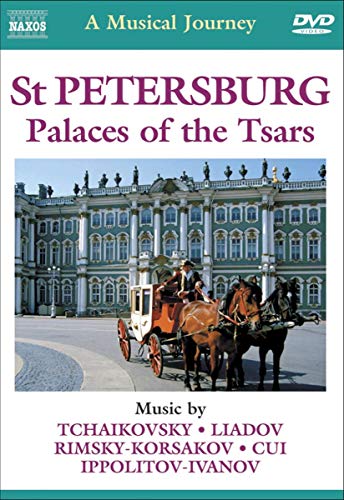
Naxos Musical Journey - St. Petersburg - Palaces Of Tsars
Naxos Musical Journey - St. Petersburg - Palaces Of Tsars
This series of DVDs features travel scenes accompanied by classical music.
The Places
St Petersburg, the former Russian capital, established in 1712 by Peter the Great, represented an era of modernisation. Built around the River Neva, which flows into the seas of the Gulf of Finland, its palaces, streets and parks, reflect the age of its construction and wider European influences to which the Tsar sought to direct his country.
The Music
The composers whose music is here included, Tchaikovsky, Rimsky-Korsakov, Cui, Liadov and Ippolitov-Ivanov, were themselves closely associated with Russian music of the later nineteenth century and, inevitably, with St Petersburg and its Conservatory.
The Places
St Petersburg, the former Russian capital, established in 1712 by Peter the Great, represented an era of modernisation. Built around the River Neva, which flows into the seas of the Gulf of Finland, its palaces, streets and parks, reflect the age of its construction and wider European influences to which the Tsar sought to direct his country.
The Music
The composers whose music is here included, Tchaikovsky, Rimsky-Korsakov, Cui, Liadov and Ippolitov-Ivanov, were themselves closely associated with Russian music of the later nineteenth century and, inevitably, with St Petersburg and its Conservatory.
$13.99
Naxos Musical Journey - St. Petersburg - Palaces Of Tsars—
$13.99
Product Information
Product Information
Shipping & Returns
Shipping & Returns
Description
This series of DVDs features travel scenes accompanied by classical music.
The Places
St Petersburg, the former Russian capital, established in 1712 by Peter the Great, represented an era of modernisation. Built around the River Neva, which flows into the seas of the Gulf of Finland, its palaces, streets and parks, reflect the age of its construction and wider European influences to which the Tsar sought to direct his country.
The Music
The composers whose music is here included, Tchaikovsky, Rimsky-Korsakov, Cui, Liadov and Ippolitov-Ivanov, were themselves closely associated with Russian music of the later nineteenth century and, inevitably, with St Petersburg and its Conservatory.
The Places
St Petersburg, the former Russian capital, established in 1712 by Peter the Great, represented an era of modernisation. Built around the River Neva, which flows into the seas of the Gulf of Finland, its palaces, streets and parks, reflect the age of its construction and wider European influences to which the Tsar sought to direct his country.
The Music
The composers whose music is here included, Tchaikovsky, Rimsky-Korsakov, Cui, Liadov and Ippolitov-Ivanov, were themselves closely associated with Russian music of the later nineteenth century and, inevitably, with St Petersburg and its Conservatory.