🚚 Free Worldwide Shipping on All Orders!Shop Now
Music Of Pierrequin De Therache
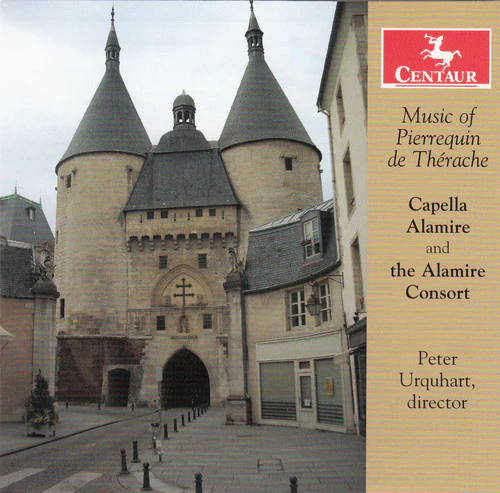
THÉRACHE Missa Comment peult avoir joye. Missa Fortuna desperate : excerpts . Missa O vos omnes : excerpts . Gaude Maria. Verbum bonum. JOSQUIN DES PREZ Comment peult avoir joye. ISAAC Missa Comment peult avoir joye —excerpt • Peter Urquhart, dir; Capella Alamire; Alamire Consort • CENTAUR 3282 (50:39 Text and Translation)
Pierrequin de Thérache (c.1470–1528) spent his career at the court of Lorraine in Nancy from 1492, serving from 1500 to 1527 as master of the choirboys. One motet heard here, Verbum bonum , is his most well-known work, not least because Mouton used it as the cantus firmus of a Mass. Peter Urquhart’s plan to present more of his work embraces an entire Mass, excerpts from two more Masses, a second motet, and related works by two contemporaries. The Josquin chanson provides the cantus firmus for the main work on this program, and Isaac’s Mass (of which we hear only a single Agnus Dei) is also based on Josquin’s chanson. All that might have been used to fill up the disc would be a sample of Mouton’s Mass, mentioned in the notes.
I knew just where to find the only previous recording of Thérache’s music in my collection, for the estimable Dominique Vellard recorded a disc for the K617 label devoted to the chapel of the dukes of Lorraine ( Fanfare 19:6). That disc included the entire Missa O vos omnes (on a motet by Loyset Compere) and the same motet Verbum bonum. Pascal Desaux, who wrote the notes and provided the research for that disc, estimated Thérache’s birth a little earlier, at c.1460. The connection between the court of Lorraine and the cathedral of Cambrai, where the unique manuscript of the Mass is found (a source as well for works of Josquin des Prez), is the brothers Loyset and Pierrequin de Thérache. They spent their early days in Cambrai, but Loyset eventually became music copyist at the cathedral, while his brother went off to Lorraine. Little wonder that the latter’s Mass found its way into the Cambrai manuscript. That Mass is heard here with the shorter pieces inserted to break up the sequence of movements (without separating the Kyrie-Gloria pair), exemplifying the familiar style of the Josquin era. The performance is of high quality, sung by a homogeneous vocal ensemble of fine tonal sheen and precise execution.
This disc deserves notice for the obscurity of the composer and the excellence of the performances, which should not have been neglected when it was issued over a year ago. The capella consists of nine singers, the consort five players. The Josquin and Isaac fillers, the only tracks that combine vocal and instrumental, are intelligent supplements to the main collection. Get acquainted with one more unfamiliar composer.
FANFARE: J. F. Weber
Product Information
Product Information
Shipping & Returns
Shipping & Returns

Music Of Pierrequin De Therache
Music Of Pierrequin De Therache
THÉRACHE Missa Comment peult avoir joye. Missa Fortuna desperate : excerpts . Missa O vos omnes : excerpts . Gaude Maria. Verbum bonum. JOSQUIN DES PREZ Comment peult avoir joye. ISAAC Missa Comment peult avoir joye —excerpt • Peter Urquhart, dir; Capella Alamire; Alamire Consort • CENTAUR 3282 (50:39 Text and Translation)
Pierrequin de Thérache (c.1470–1528) spent his career at the court of Lorraine in Nancy from 1492, serving from 1500 to 1527 as master of the choirboys. One motet heard here, Verbum bonum , is his most well-known work, not least because Mouton used it as the cantus firmus of a Mass. Peter Urquhart’s plan to present more of his work embraces an entire Mass, excerpts from two more Masses, a second motet, and related works by two contemporaries. The Josquin chanson provides the cantus firmus for the main work on this program, and Isaac’s Mass (of which we hear only a single Agnus Dei) is also based on Josquin’s chanson. All that might have been used to fill up the disc would be a sample of Mouton’s Mass, mentioned in the notes.
I knew just where to find the only previous recording of Thérache’s music in my collection, for the estimable Dominique Vellard recorded a disc for the K617 label devoted to the chapel of the dukes of Lorraine ( Fanfare 19:6). That disc included the entire Missa O vos omnes (on a motet by Loyset Compere) and the same motet Verbum bonum. Pascal Desaux, who wrote the notes and provided the research for that disc, estimated Thérache’s birth a little earlier, at c.1460. The connection between the court of Lorraine and the cathedral of Cambrai, where the unique manuscript of the Mass is found (a source as well for works of Josquin des Prez), is the brothers Loyset and Pierrequin de Thérache. They spent their early days in Cambrai, but Loyset eventually became music copyist at the cathedral, while his brother went off to Lorraine. Little wonder that the latter’s Mass found its way into the Cambrai manuscript. That Mass is heard here with the shorter pieces inserted to break up the sequence of movements (without separating the Kyrie-Gloria pair), exemplifying the familiar style of the Josquin era. The performance is of high quality, sung by a homogeneous vocal ensemble of fine tonal sheen and precise execution.
This disc deserves notice for the obscurity of the composer and the excellence of the performances, which should not have been neglected when it was issued over a year ago. The capella consists of nine singers, the consort five players. The Josquin and Isaac fillers, the only tracks that combine vocal and instrumental, are intelligent supplements to the main collection. Get acquainted with one more unfamiliar composer.
FANFARE: J. F. Weber
$18.99
Music Of Pierrequin De Therache—
$18.99
Product Information
Product Information
Shipping & Returns
Shipping & Returns
Description
THÉRACHE Missa Comment peult avoir joye. Missa Fortuna desperate : excerpts . Missa O vos omnes : excerpts . Gaude Maria. Verbum bonum. JOSQUIN DES PREZ Comment peult avoir joye. ISAAC Missa Comment peult avoir joye —excerpt • Peter Urquhart, dir; Capella Alamire; Alamire Consort • CENTAUR 3282 (50:39 Text and Translation)
Pierrequin de Thérache (c.1470–1528) spent his career at the court of Lorraine in Nancy from 1492, serving from 1500 to 1527 as master of the choirboys. One motet heard here, Verbum bonum , is his most well-known work, not least because Mouton used it as the cantus firmus of a Mass. Peter Urquhart’s plan to present more of his work embraces an entire Mass, excerpts from two more Masses, a second motet, and related works by two contemporaries. The Josquin chanson provides the cantus firmus for the main work on this program, and Isaac’s Mass (of which we hear only a single Agnus Dei) is also based on Josquin’s chanson. All that might have been used to fill up the disc would be a sample of Mouton’s Mass, mentioned in the notes.
I knew just where to find the only previous recording of Thérache’s music in my collection, for the estimable Dominique Vellard recorded a disc for the K617 label devoted to the chapel of the dukes of Lorraine ( Fanfare 19:6). That disc included the entire Missa O vos omnes (on a motet by Loyset Compere) and the same motet Verbum bonum. Pascal Desaux, who wrote the notes and provided the research for that disc, estimated Thérache’s birth a little earlier, at c.1460. The connection between the court of Lorraine and the cathedral of Cambrai, where the unique manuscript of the Mass is found (a source as well for works of Josquin des Prez), is the brothers Loyset and Pierrequin de Thérache. They spent their early days in Cambrai, but Loyset eventually became music copyist at the cathedral, while his brother went off to Lorraine. Little wonder that the latter’s Mass found its way into the Cambrai manuscript. That Mass is heard here with the shorter pieces inserted to break up the sequence of movements (without separating the Kyrie-Gloria pair), exemplifying the familiar style of the Josquin era. The performance is of high quality, sung by a homogeneous vocal ensemble of fine tonal sheen and precise execution.
This disc deserves notice for the obscurity of the composer and the excellence of the performances, which should not have been neglected when it was issued over a year ago. The capella consists of nine singers, the consort five players. The Josquin and Isaac fillers, the only tracks that combine vocal and instrumental, are intelligent supplements to the main collection. Get acquainted with one more unfamiliar composer.
FANFARE: J. F. Weber