🚚 Free Worldwide Shipping on All Orders!Shop Now
Loeb: The Lyric Trombone / Avitsur, Locker, Yajima
Contemporary American Composer David Loeb: "The choice of the trombone of pieces might engender some surprise, but the trombone has the necessary diversity of resources." These great works will make this point abundantly obvious. David Loeb was born in 1939 in New York into a family which took music and painting very seriously. He studied composition with Peter Pindar Stearns at the Mannes College of Music in New York, and then completed a master's degree at Yale. His catalog of compositions is unusually extensive and diverse. In addition to the expected assortment of works for orchestra, various chamber combinations, soloists, and voice, he has also written many pieces for Asian instruments (in addition to Japanese, some for Chinese, Korean, Thai, and Mongol) and for early Western instruments (in addition to viols, some for lute, harpsichord, and recorder). He has often brought these instruments together in unique combinations, such as four shakuhachi and four viols; flute, guitar, koto, and shakuhachi; and khaen, flute, guitar, cello, and percussion.
Product Information
Product Information
Shipping & Returns
Shipping & Returns

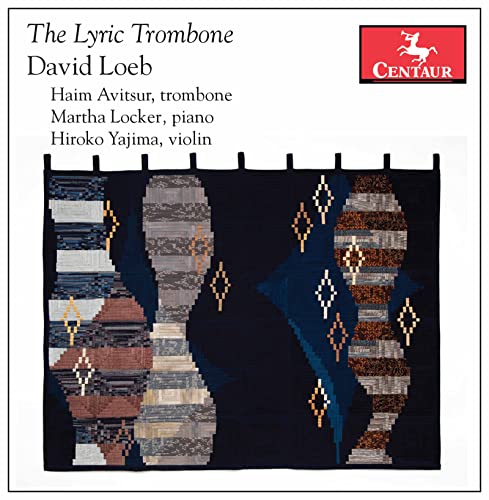
Loeb: The Lyric Trombone / Avitsur, Locker, Yajima
Loeb: The Lyric Trombone / Avitsur, Locker, Yajima
Contemporary American Composer David Loeb: "The choice of the trombone of pieces might engender some surprise, but the trombone has the necessary diversity of resources." These great works will make this point abundantly obvious. David Loeb was born in 1939 in New York into a family which took music and painting very seriously. He studied composition with Peter Pindar Stearns at the Mannes College of Music in New York, and then completed a master's degree at Yale. His catalog of compositions is unusually extensive and diverse. In addition to the expected assortment of works for orchestra, various chamber combinations, soloists, and voice, he has also written many pieces for Asian instruments (in addition to Japanese, some for Chinese, Korean, Thai, and Mongol) and for early Western instruments (in addition to viols, some for lute, harpsichord, and recorder). He has often brought these instruments together in unique combinations, such as four shakuhachi and four viols; flute, guitar, koto, and shakuhachi; and khaen, flute, guitar, cello, and percussion.
$5.25
Original: $14.99
-65%Loeb: The Lyric Trombone / Avitsur, Locker, Yajima—
$14.99
$5.25Product Information
Product Information
Shipping & Returns
Shipping & Returns
Description
Contemporary American Composer David Loeb: "The choice of the trombone of pieces might engender some surprise, but the trombone has the necessary diversity of resources." These great works will make this point abundantly obvious. David Loeb was born in 1939 in New York into a family which took music and painting very seriously. He studied composition with Peter Pindar Stearns at the Mannes College of Music in New York, and then completed a master's degree at Yale. His catalog of compositions is unusually extensive and diverse. In addition to the expected assortment of works for orchestra, various chamber combinations, soloists, and voice, he has also written many pieces for Asian instruments (in addition to Japanese, some for Chinese, Korean, Thai, and Mongol) and for early Western instruments (in addition to viols, some for lute, harpsichord, and recorder). He has often brought these instruments together in unique combinations, such as four shakuhachi and four viols; flute, guitar, koto, and shakuhachi; and khaen, flute, guitar, cello, and percussion.