🚚 Free Worldwide Shipping on All Orders!Shop Now
Enescu: Strigoii / Bebeselea, Berlin Radio Symphony
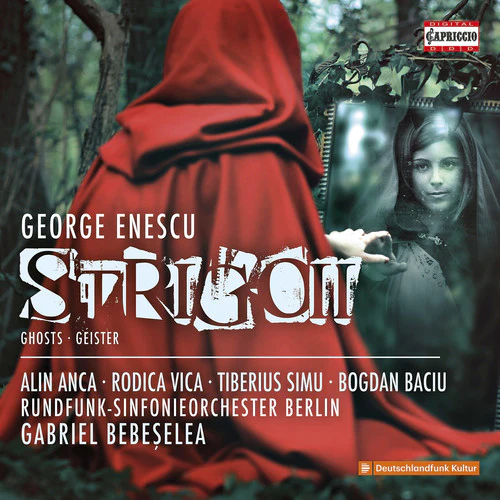
In December 2017 soprano Rodica Vica made the world premiere recording of George Enescu’s Ghosts (Strigoii) alongside the Rundfunk- Sinfonieorchester Berlin led by conductor Gabriel Bebe?elea. Nobody knew anything about George Enescu’s oratorium Strigoii. The script, lost together with other items in the turmoil of the First World War, was purchased back by the Director of the Enescu Museum. To make it easier to understand how Strigoii was created, it was necessary to undertake the decipherment and reconstruction of the manuscript. When Enescu approached Strigoii in 1916, it was the result of an older admiration for the poet Mihai Eminescu that was to last until the end of the composer’s life. Whilst Enescu evinces some similarities to German Romanticism in his poem (Novalis or Tieck), in Strigoii Enescu also shows stylistic affinities to some contemporaries such as Alexander von Zemlinsky or the young Alban Berg.
-----
REVIEW:
Both works here are world premiere recordings. Strigoii was designated by Enescu as an oratorio, although it would seem better to fit the description of secular cantata. It was composed in 1916 for full orchestra, choir and soloists in three parts, to a text which is a poem by Mihai Eminescu (1850–1889); the score was presumed lost during the First World War but eventually re-discovered and purchased by the director of the Enescu Museum, who gave a photocopy of the manuscript to Cornel ??ranu, the arranger here. Dramatically, thematically, textually and musically, it has much in common with two works both written five years earlier: Schoenberg’s Gurre-Lieder, also in three parts and Bartók’s Duke Bluebeard’s Castle, all with elements that can ultimately be traced back to the post-Romantic trope of “Love in Death” epitomised in the “Liebestod” of Tristan und Isolde, but stylistically the influences of Zemlinsky and Berg can be detected in the score. Interestingly, the German translation of what is rendered in English as “Ghosts” is “Geister” on the cover but the translation of the poem in the booklet is entitled “Vampyre”, which puts a rather different and darker complexion upon the tale.
??ranu’s reconstruction has been richly orchestrated by composer Sabin Pautza. It purportedly sets the entire text of Eminescu’s poem, although in track 5, Part II, the action omits six stanzas of the original present in the libretto, thereby leaping from King Arald’s plea to the Seer to bring his beloved back from the dead to his spell, excising the narrative description of the preparation and build-up to its incantation. Insofar as I can tell, not speaking Romanian but being familiar with other Romance languages and having the English translation to follow, the poetry is beautiful and it certainly adds interest to hear the language sung so idiomatically by native speakers.
“Free declamation” or “Sprechgesang” is sometimes employed by the tenor and bass, and the music is highly chromatic in approach, giving it a nebulous and free-floating character and making it hard for the amateur ear to pin down its shape. The through-composed music does not so much accompany the vocal lines as provide a kind of eerie, atmospheric backdrop to them. I certainly find myself frequently reminded of the atmosphere of Bluebeard while listening, especially as so much of the music is for the bass, but especially striking is the tenor Arald’s searing, soaring narration of how his passionate, all-consuming love for his Queen was stirred into being. All four singers here are first-rate, especially the incisive baritone who sings the Magus. My experience of Romanian opera hitherto has been limited to Enescu’s life’s work and masterpiece, the beautiful, refined and densely orchestrated Oedipe, and the operas of Nicolae Bretan, whose own libretto for his Arald was based on the same poem as Enescu sets here; likewise, the text for Luceaf?rul, was again derived from an Eminescu poem. Both were first recorded by Nimbus and well worth exploring, while the best recording of Oedipe remains that from EMI with José Van Dam, but I certainly also welcome this new addition to the canon, even though I find Enescu’s idiom here quite challenging.
Pastorale fantaisie is a youthful work, written in 1899, when the composer was only eighteen. For a number of reasons, it was not given an opus number or published, and was re-discovered only in 2017 by the conductor here, Gabriel Bebe?elea, who transcribed it from the manuscript and directed its second performance 118 years after its premiere. Its structure is tripartite and employs two fugues as its main musical ideas, culminating in a grand coda; it is evidently indebted to Baroque models. The gentle, undulating, then descending, opening theme gives it an airy, pastoral quality, contrasting strongly with the ensuing stormy sections, reinforcing any association we might have with the Beethovenian allusion contained within the work’s title; despite its formal, archaic structure, it emerges as sounding more modern, perhaps more like an attractive tone poem.
– MusicWeb International (Ralph Moore)
-----
REVIEW:
Both works here are world premiere recordings. Strigoii was designated by Enescu as an oratorio, although it would seem better to fit the description of secular cantata. It was composed in 1916 for full orchestra, choir and soloists in three parts, to a text which is a poem by Mihai Eminescu (1850–1889); the score was presumed lost during the First World War but eventually re-discovered and purchased by the director of the Enescu Museum, who gave a photocopy of the manuscript to Cornel ??ranu, the arranger here. Dramatically, thematically, textually and musically, it has much in common with two works both written five years earlier: Schoenberg’s Gurre-Lieder, also in three parts and Bartók’s Duke Bluebeard’s Castle, all with elements that can ultimately be traced back to the post-Romantic trope of “Love in Death” epitomised in the “Liebestod” of Tristan und Isolde, but stylistically the influences of Zemlinsky and Berg can be detected in the score. Interestingly, the German translation of what is rendered in English as “Ghosts” is “Geister” on the cover but the translation of the poem in the booklet is entitled “Vampyre”, which puts a rather different and darker complexion upon the tale.
??ranu’s reconstruction has been richly orchestrated by composer Sabin Pautza. It purportedly sets the entire text of Eminescu’s poem, although in track 5, Part II, the action omits six stanzas of the original present in the libretto, thereby leaping from King Arald’s plea to the Seer to bring his beloved back from the dead to his spell, excising the narrative description of the preparation and build-up to its incantation. Insofar as I can tell, not speaking Romanian but being familiar with other Romance languages and having the English translation to follow, the poetry is beautiful and it certainly adds interest to hear the language sung so idiomatically by native speakers.
“Free declamation” or “Sprechgesang” is sometimes employed by the tenor and bass, and the music is highly chromatic in approach, giving it a nebulous and free-floating character and making it hard for the amateur ear to pin down its shape. The through-composed music does not so much accompany the vocal lines as provide a kind of eerie, atmospheric backdrop to them. I certainly find myself frequently reminded of the atmosphere of Bluebeard while listening, especially as so much of the music is for the bass, but especially striking is the tenor Arald’s searing, soaring narration of how his passionate, all-consuming love for his Queen was stirred into being. All four singers here are first-rate, especially the incisive baritone who sings the Magus. My experience of Romanian opera hitherto has been limited to Enescu’s life’s work and masterpiece, the beautiful, refined and densely orchestrated Oedipe, and the operas of Nicolae Bretan, whose own libretto for his Arald was based on the same poem as Enescu sets here; likewise, the text for Luceaf?rul, was again derived from an Eminescu poem. Both were first recorded by Nimbus and well worth exploring, while the best recording of Oedipe remains that from EMI with José Van Dam, but I certainly also welcome this new addition to the canon, even though I find Enescu’s idiom here quite challenging.
Pastorale fantaisie is a youthful work, written in 1899, when the composer was only eighteen. For a number of reasons, it was not given an opus number or published, and was re-discovered only in 2017 by the conductor here, Gabriel Bebe?elea, who transcribed it from the manuscript and directed its second performance 118 years after its premiere. Its structure is tripartite and employs two fugues as its main musical ideas, culminating in a grand coda; it is evidently indebted to Baroque models. The gentle, undulating, then descending, opening theme gives it an airy, pastoral quality, contrasting strongly with the ensuing stormy sections, reinforcing any association we might have with the Beethovenian allusion contained within the work’s title; despite its formal, archaic structure, it emerges as sounding more modern, perhaps more like an attractive tone poem.
– MusicWeb International (Ralph Moore)
Product Information
Product Information
Shipping & Returns
Shipping & Returns
Enescu: Strigoii / Bebeselea, Berlin Radio Symphony
Enescu: Strigoii / Bebeselea, Berlin Radio Symphony
In December 2017 soprano Rodica Vica made the world premiere recording of George Enescu’s Ghosts (Strigoii) alongside the Rundfunk- Sinfonieorchester Berlin led by conductor Gabriel Bebe?elea. Nobody knew anything about George Enescu’s oratorium Strigoii. The script, lost together with other items in the turmoil of the First World War, was purchased back by the Director of the Enescu Museum. To make it easier to understand how Strigoii was created, it was necessary to undertake the decipherment and reconstruction of the manuscript. When Enescu approached Strigoii in 1916, it was the result of an older admiration for the poet Mihai Eminescu that was to last until the end of the composer’s life. Whilst Enescu evinces some similarities to German Romanticism in his poem (Novalis or Tieck), in Strigoii Enescu also shows stylistic affinities to some contemporaries such as Alexander von Zemlinsky or the young Alban Berg.
-----
REVIEW:
Both works here are world premiere recordings. Strigoii was designated by Enescu as an oratorio, although it would seem better to fit the description of secular cantata. It was composed in 1916 for full orchestra, choir and soloists in three parts, to a text which is a poem by Mihai Eminescu (1850–1889); the score was presumed lost during the First World War but eventually re-discovered and purchased by the director of the Enescu Museum, who gave a photocopy of the manuscript to Cornel ??ranu, the arranger here. Dramatically, thematically, textually and musically, it has much in common with two works both written five years earlier: Schoenberg’s Gurre-Lieder, also in three parts and Bartók’s Duke Bluebeard’s Castle, all with elements that can ultimately be traced back to the post-Romantic trope of “Love in Death” epitomised in the “Liebestod” of Tristan und Isolde, but stylistically the influences of Zemlinsky and Berg can be detected in the score. Interestingly, the German translation of what is rendered in English as “Ghosts” is “Geister” on the cover but the translation of the poem in the booklet is entitled “Vampyre”, which puts a rather different and darker complexion upon the tale.
??ranu’s reconstruction has been richly orchestrated by composer Sabin Pautza. It purportedly sets the entire text of Eminescu’s poem, although in track 5, Part II, the action omits six stanzas of the original present in the libretto, thereby leaping from King Arald’s plea to the Seer to bring his beloved back from the dead to his spell, excising the narrative description of the preparation and build-up to its incantation. Insofar as I can tell, not speaking Romanian but being familiar with other Romance languages and having the English translation to follow, the poetry is beautiful and it certainly adds interest to hear the language sung so idiomatically by native speakers.
“Free declamation” or “Sprechgesang” is sometimes employed by the tenor and bass, and the music is highly chromatic in approach, giving it a nebulous and free-floating character and making it hard for the amateur ear to pin down its shape. The through-composed music does not so much accompany the vocal lines as provide a kind of eerie, atmospheric backdrop to them. I certainly find myself frequently reminded of the atmosphere of Bluebeard while listening, especially as so much of the music is for the bass, but especially striking is the tenor Arald’s searing, soaring narration of how his passionate, all-consuming love for his Queen was stirred into being. All four singers here are first-rate, especially the incisive baritone who sings the Magus. My experience of Romanian opera hitherto has been limited to Enescu’s life’s work and masterpiece, the beautiful, refined and densely orchestrated Oedipe, and the operas of Nicolae Bretan, whose own libretto for his Arald was based on the same poem as Enescu sets here; likewise, the text for Luceaf?rul, was again derived from an Eminescu poem. Both were first recorded by Nimbus and well worth exploring, while the best recording of Oedipe remains that from EMI with José Van Dam, but I certainly also welcome this new addition to the canon, even though I find Enescu’s idiom here quite challenging.
Pastorale fantaisie is a youthful work, written in 1899, when the composer was only eighteen. For a number of reasons, it was not given an opus number or published, and was re-discovered only in 2017 by the conductor here, Gabriel Bebe?elea, who transcribed it from the manuscript and directed its second performance 118 years after its premiere. Its structure is tripartite and employs two fugues as its main musical ideas, culminating in a grand coda; it is evidently indebted to Baroque models. The gentle, undulating, then descending, opening theme gives it an airy, pastoral quality, contrasting strongly with the ensuing stormy sections, reinforcing any association we might have with the Beethovenian allusion contained within the work’s title; despite its formal, archaic structure, it emerges as sounding more modern, perhaps more like an attractive tone poem.
– MusicWeb International (Ralph Moore)
-----
REVIEW:
Both works here are world premiere recordings. Strigoii was designated by Enescu as an oratorio, although it would seem better to fit the description of secular cantata. It was composed in 1916 for full orchestra, choir and soloists in three parts, to a text which is a poem by Mihai Eminescu (1850–1889); the score was presumed lost during the First World War but eventually re-discovered and purchased by the director of the Enescu Museum, who gave a photocopy of the manuscript to Cornel ??ranu, the arranger here. Dramatically, thematically, textually and musically, it has much in common with two works both written five years earlier: Schoenberg’s Gurre-Lieder, also in three parts and Bartók’s Duke Bluebeard’s Castle, all with elements that can ultimately be traced back to the post-Romantic trope of “Love in Death” epitomised in the “Liebestod” of Tristan und Isolde, but stylistically the influences of Zemlinsky and Berg can be detected in the score. Interestingly, the German translation of what is rendered in English as “Ghosts” is “Geister” on the cover but the translation of the poem in the booklet is entitled “Vampyre”, which puts a rather different and darker complexion upon the tale.
??ranu’s reconstruction has been richly orchestrated by composer Sabin Pautza. It purportedly sets the entire text of Eminescu’s poem, although in track 5, Part II, the action omits six stanzas of the original present in the libretto, thereby leaping from King Arald’s plea to the Seer to bring his beloved back from the dead to his spell, excising the narrative description of the preparation and build-up to its incantation. Insofar as I can tell, not speaking Romanian but being familiar with other Romance languages and having the English translation to follow, the poetry is beautiful and it certainly adds interest to hear the language sung so idiomatically by native speakers.
“Free declamation” or “Sprechgesang” is sometimes employed by the tenor and bass, and the music is highly chromatic in approach, giving it a nebulous and free-floating character and making it hard for the amateur ear to pin down its shape. The through-composed music does not so much accompany the vocal lines as provide a kind of eerie, atmospheric backdrop to them. I certainly find myself frequently reminded of the atmosphere of Bluebeard while listening, especially as so much of the music is for the bass, but especially striking is the tenor Arald’s searing, soaring narration of how his passionate, all-consuming love for his Queen was stirred into being. All four singers here are first-rate, especially the incisive baritone who sings the Magus. My experience of Romanian opera hitherto has been limited to Enescu’s life’s work and masterpiece, the beautiful, refined and densely orchestrated Oedipe, and the operas of Nicolae Bretan, whose own libretto for his Arald was based on the same poem as Enescu sets here; likewise, the text for Luceaf?rul, was again derived from an Eminescu poem. Both were first recorded by Nimbus and well worth exploring, while the best recording of Oedipe remains that from EMI with José Van Dam, but I certainly also welcome this new addition to the canon, even though I find Enescu’s idiom here quite challenging.
Pastorale fantaisie is a youthful work, written in 1899, when the composer was only eighteen. For a number of reasons, it was not given an opus number or published, and was re-discovered only in 2017 by the conductor here, Gabriel Bebe?elea, who transcribed it from the manuscript and directed its second performance 118 years after its premiere. Its structure is tripartite and employs two fugues as its main musical ideas, culminating in a grand coda; it is evidently indebted to Baroque models. The gentle, undulating, then descending, opening theme gives it an airy, pastoral quality, contrasting strongly with the ensuing stormy sections, reinforcing any association we might have with the Beethovenian allusion contained within the work’s title; despite its formal, archaic structure, it emerges as sounding more modern, perhaps more like an attractive tone poem.
– MusicWeb International (Ralph Moore)
$21.99
Enescu: Strigoii / Bebeselea, Berlin Radio Symphony—
$21.99
Product Information
Product Information
Shipping & Returns
Shipping & Returns
Description
In December 2017 soprano Rodica Vica made the world premiere recording of George Enescu’s Ghosts (Strigoii) alongside the Rundfunk- Sinfonieorchester Berlin led by conductor Gabriel Bebe?elea. Nobody knew anything about George Enescu’s oratorium Strigoii. The script, lost together with other items in the turmoil of the First World War, was purchased back by the Director of the Enescu Museum. To make it easier to understand how Strigoii was created, it was necessary to undertake the decipherment and reconstruction of the manuscript. When Enescu approached Strigoii in 1916, it was the result of an older admiration for the poet Mihai Eminescu that was to last until the end of the composer’s life. Whilst Enescu evinces some similarities to German Romanticism in his poem (Novalis or Tieck), in Strigoii Enescu also shows stylistic affinities to some contemporaries such as Alexander von Zemlinsky or the young Alban Berg.
-----
REVIEW:
Both works here are world premiere recordings. Strigoii was designated by Enescu as an oratorio, although it would seem better to fit the description of secular cantata. It was composed in 1916 for full orchestra, choir and soloists in three parts, to a text which is a poem by Mihai Eminescu (1850–1889); the score was presumed lost during the First World War but eventually re-discovered and purchased by the director of the Enescu Museum, who gave a photocopy of the manuscript to Cornel ??ranu, the arranger here. Dramatically, thematically, textually and musically, it has much in common with two works both written five years earlier: Schoenberg’s Gurre-Lieder, also in three parts and Bartók’s Duke Bluebeard’s Castle, all with elements that can ultimately be traced back to the post-Romantic trope of “Love in Death” epitomised in the “Liebestod” of Tristan und Isolde, but stylistically the influences of Zemlinsky and Berg can be detected in the score. Interestingly, the German translation of what is rendered in English as “Ghosts” is “Geister” on the cover but the translation of the poem in the booklet is entitled “Vampyre”, which puts a rather different and darker complexion upon the tale.
??ranu’s reconstruction has been richly orchestrated by composer Sabin Pautza. It purportedly sets the entire text of Eminescu’s poem, although in track 5, Part II, the action omits six stanzas of the original present in the libretto, thereby leaping from King Arald’s plea to the Seer to bring his beloved back from the dead to his spell, excising the narrative description of the preparation and build-up to its incantation. Insofar as I can tell, not speaking Romanian but being familiar with other Romance languages and having the English translation to follow, the poetry is beautiful and it certainly adds interest to hear the language sung so idiomatically by native speakers.
“Free declamation” or “Sprechgesang” is sometimes employed by the tenor and bass, and the music is highly chromatic in approach, giving it a nebulous and free-floating character and making it hard for the amateur ear to pin down its shape. The through-composed music does not so much accompany the vocal lines as provide a kind of eerie, atmospheric backdrop to them. I certainly find myself frequently reminded of the atmosphere of Bluebeard while listening, especially as so much of the music is for the bass, but especially striking is the tenor Arald’s searing, soaring narration of how his passionate, all-consuming love for his Queen was stirred into being. All four singers here are first-rate, especially the incisive baritone who sings the Magus. My experience of Romanian opera hitherto has been limited to Enescu’s life’s work and masterpiece, the beautiful, refined and densely orchestrated Oedipe, and the operas of Nicolae Bretan, whose own libretto for his Arald was based on the same poem as Enescu sets here; likewise, the text for Luceaf?rul, was again derived from an Eminescu poem. Both were first recorded by Nimbus and well worth exploring, while the best recording of Oedipe remains that from EMI with José Van Dam, but I certainly also welcome this new addition to the canon, even though I find Enescu’s idiom here quite challenging.
Pastorale fantaisie is a youthful work, written in 1899, when the composer was only eighteen. For a number of reasons, it was not given an opus number or published, and was re-discovered only in 2017 by the conductor here, Gabriel Bebe?elea, who transcribed it from the manuscript and directed its second performance 118 years after its premiere. Its structure is tripartite and employs two fugues as its main musical ideas, culminating in a grand coda; it is evidently indebted to Baroque models. The gentle, undulating, then descending, opening theme gives it an airy, pastoral quality, contrasting strongly with the ensuing stormy sections, reinforcing any association we might have with the Beethovenian allusion contained within the work’s title; despite its formal, archaic structure, it emerges as sounding more modern, perhaps more like an attractive tone poem.
– MusicWeb International (Ralph Moore)
-----
REVIEW:
Both works here are world premiere recordings. Strigoii was designated by Enescu as an oratorio, although it would seem better to fit the description of secular cantata. It was composed in 1916 for full orchestra, choir and soloists in three parts, to a text which is a poem by Mihai Eminescu (1850–1889); the score was presumed lost during the First World War but eventually re-discovered and purchased by the director of the Enescu Museum, who gave a photocopy of the manuscript to Cornel ??ranu, the arranger here. Dramatically, thematically, textually and musically, it has much in common with two works both written five years earlier: Schoenberg’s Gurre-Lieder, also in three parts and Bartók’s Duke Bluebeard’s Castle, all with elements that can ultimately be traced back to the post-Romantic trope of “Love in Death” epitomised in the “Liebestod” of Tristan und Isolde, but stylistically the influences of Zemlinsky and Berg can be detected in the score. Interestingly, the German translation of what is rendered in English as “Ghosts” is “Geister” on the cover but the translation of the poem in the booklet is entitled “Vampyre”, which puts a rather different and darker complexion upon the tale.
??ranu’s reconstruction has been richly orchestrated by composer Sabin Pautza. It purportedly sets the entire text of Eminescu’s poem, although in track 5, Part II, the action omits six stanzas of the original present in the libretto, thereby leaping from King Arald’s plea to the Seer to bring his beloved back from the dead to his spell, excising the narrative description of the preparation and build-up to its incantation. Insofar as I can tell, not speaking Romanian but being familiar with other Romance languages and having the English translation to follow, the poetry is beautiful and it certainly adds interest to hear the language sung so idiomatically by native speakers.
“Free declamation” or “Sprechgesang” is sometimes employed by the tenor and bass, and the music is highly chromatic in approach, giving it a nebulous and free-floating character and making it hard for the amateur ear to pin down its shape. The through-composed music does not so much accompany the vocal lines as provide a kind of eerie, atmospheric backdrop to them. I certainly find myself frequently reminded of the atmosphere of Bluebeard while listening, especially as so much of the music is for the bass, but especially striking is the tenor Arald’s searing, soaring narration of how his passionate, all-consuming love for his Queen was stirred into being. All four singers here are first-rate, especially the incisive baritone who sings the Magus. My experience of Romanian opera hitherto has been limited to Enescu’s life’s work and masterpiece, the beautiful, refined and densely orchestrated Oedipe, and the operas of Nicolae Bretan, whose own libretto for his Arald was based on the same poem as Enescu sets here; likewise, the text for Luceaf?rul, was again derived from an Eminescu poem. Both were first recorded by Nimbus and well worth exploring, while the best recording of Oedipe remains that from EMI with José Van Dam, but I certainly also welcome this new addition to the canon, even though I find Enescu’s idiom here quite challenging.
Pastorale fantaisie is a youthful work, written in 1899, when the composer was only eighteen. For a number of reasons, it was not given an opus number or published, and was re-discovered only in 2017 by the conductor here, Gabriel Bebe?elea, who transcribed it from the manuscript and directed its second performance 118 years after its premiere. Its structure is tripartite and employs two fugues as its main musical ideas, culminating in a grand coda; it is evidently indebted to Baroque models. The gentle, undulating, then descending, opening theme gives it an airy, pastoral quality, contrasting strongly with the ensuing stormy sections, reinforcing any association we might have with the Beethovenian allusion contained within the work’s title; despite its formal, archaic structure, it emerges as sounding more modern, perhaps more like an attractive tone poem.
– MusicWeb International (Ralph Moore)