🚚 Free Worldwide Shipping on All Orders!Shop Now
Dvorak: Cypresses - Song Cycle & String Quartet / Ullmann, Bruns
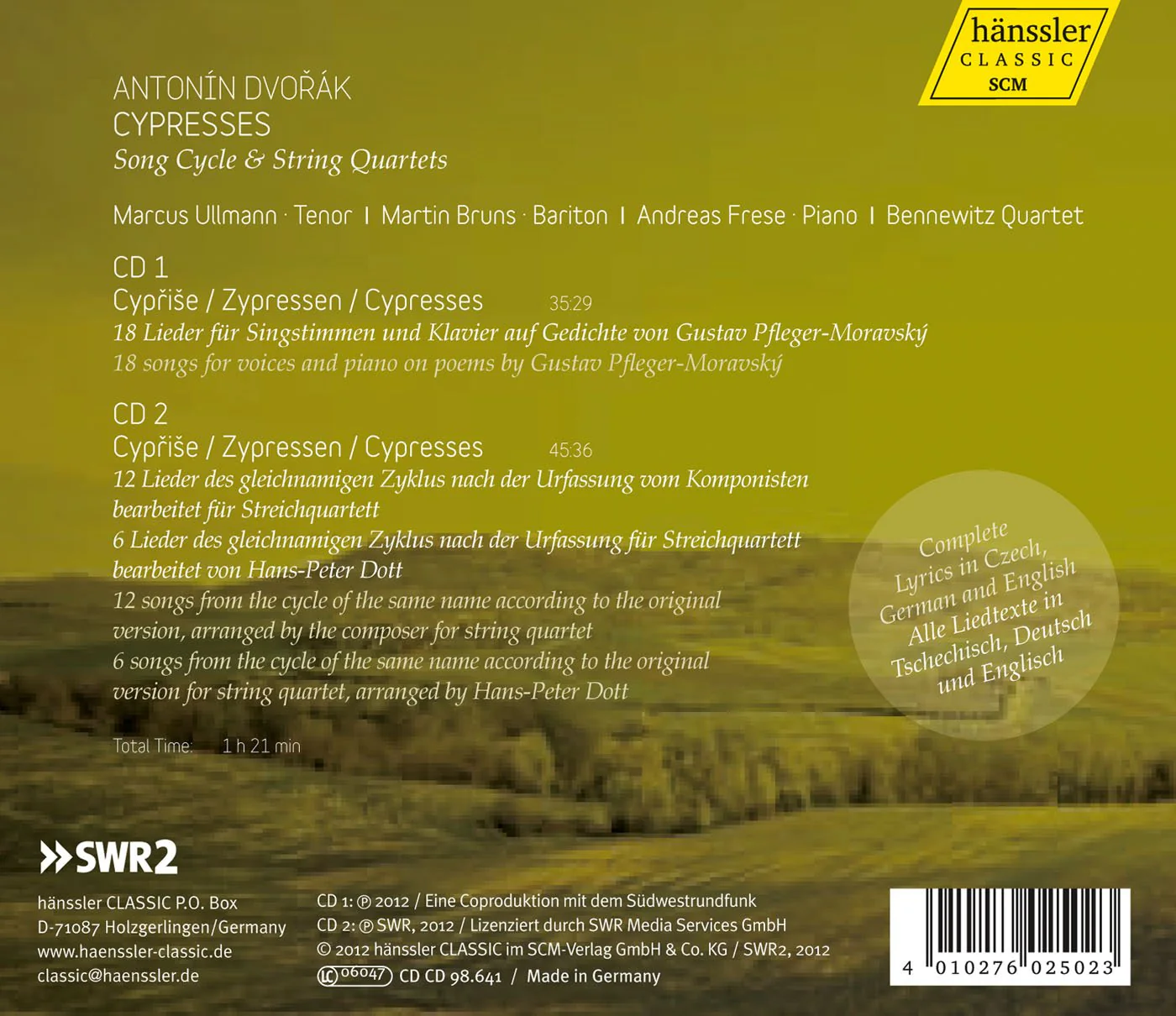
DVORÁK Cypresses: 18 Songs for Voices and Piano (original version, 1865 1 ). Cypresses: 12 Songs for String Quartet (from original version, arr. Dvorák 2 ). Cypresses: 6 Songs for String Quartet (from original version, arr. Hans-Peter Dott 2 ) • 1 Marcus Ullmann (ten); 1 Martin Bruns (bar); 1 Andreas Frese (pn); 2 Bennewitz Qrt • HÄNSSLER 98641 (2 CDs: 81:05 Text and Translation)
Let me begin with just one swipe at Hänssler Classic, a label whose marketing practices I’ve questioned before. This entire program could fit onto a single CD. Discs of over 80 minutes, once rare, are now fairly common. A saving grace, however, is that as of now, mid-October 2012, ArkivMusic is selling the two-disc set for $26.99, which places it in the mid-price category on a per-disc basis. Hänssler is to be commended, however, for coming up with the idea of presenting Dvorák’s Cypresses complete in its original scoring as a song cycle for voices and piano, plus in its partial arrangement of 12 of the 18 songs for string quartet by the composer himself, and, in addition, in arrangements of the remaining six songs for string quartet by German composer Hans-Peter Dott (b. 1952). If anyone has done this before, it’s not reflected in any of the current listings I found. In fact, Dvorak’s string quartet arrangements far outnumber recordings of the song cycle.
Details of the song cycle’s path from composition to publication still remain a bit sketchy and open to some dispute. This much is known: Dvorák set the songs down on paper in 17 days between the 10th and 27th of July 1865. The 24-year-old composer was lovesick over one of his young pupils who didn’t share his feelings. So, like Mozart, Dvorák ended up settling for the girl’s younger sister, whom he eventually married. It’s hardly surprising then that the texts of the songs, taken from Cypresses: A Collection of Lyric and Epic Poems by Gustav Pfleger-Moravský, tell of unrequited love. Also generally agreed upon is that Dvorák intended eight of the songs—Nos. 1, 2, 5, 7, 8, 13, 14, and 15—to be sung by a tenor, while the remaining 10 songs—Nos. 3, 4, 6, 9, 10, 11, 12, 16, 17, and 18—were intended to be taken by a baritone, which is the way they’re divvied up on the disc.
But here’s where things get a bit dicey. It took Dvorák another 23 years, during which he arranged, rearranged, and otherwise tinkered with the songs, before he sent them to Simrock for publication in 1888 with the title, not Cypresses , but Love Songs , to which the opus number 83 was assigned. Yet a 2012 program note from the Chamber Music Society of Williamsburg unequivocally states that “Dvorák chose never to publish the songs in their original form, but material from several of the songs cropped up in his first two symphonies and in his operas and other vocal works.” Clearly, the songs were published in 1888, but I’m guessing that the discrepancy hinges on the words “in their original form,” for according to the imslp.org catalog of Dvorák’s complete works, the songs that were actually published were all third and fourth revisions of the originals. Meanwhile, a year earlier the composer selected 12 of the songs—Nos. 2, 3, 4, 6, 7, 8, 9, 12, 14, 16, 17, and 18— and began reworking them for string quartet, keeping close to the original models. He made only some minor rhythmic adjustments, and only in one case did he change the key. He did, however, reorder the pieces in a different sequence from the original song cycle—6, 3, 2, 8, 12, 7, 9, 14, 4, 16, 17, 18—and titled his collection of quartet arrangements Echo of Songs . These were not published, however, until 1921, 17 years after Dvorák’s death.
This brings up another misunderstanding that has been perpetuated regarding Dvorák’s titling of both the published song cycle and the string quartet arrangements that remained unpublished in his lifetime. All Music Guide states that it was the composer himself who named the song cycle Cypresses , but as noted above, he didn’t. He titled it Love Songs . And as for the composer’s quartet arrangements of 12 of the songs, he called them, again as noted above, Echo of Songs . The only Cypresses Dvorák was familiar with, other than the trees, was the collection of poems so titled by Pfleger-Moravský. The Cypresses title was conferred upon the string quartet arrangements—and then only retroactively and by association with the songs—by the publisher of the string quartet cycle, Hudební matice umrlecké besedy, and/or the cycle’s editor, composer Josef Suk. Hans-Peter Dott surmises there are reasons Dvorák omitted the six songs—1, 5, 10, 11, 13, and 15—from his own quartet arrangements, but Dott doesn’t tells us what those reasons might have been. Instead, he decided to arrange them himself anyway, and they’re included as the last six tracks on disc 2, after Dvorák’s 12.
So, there you have it: the complete song cycle, published in 1888 as Love Songs , Dvorák’s own string quartet arrangements he titled Echo of Song , published in 1921, and a recent arrangement by Dott of the remaining six songs—all on a two-disc set boldly titled “Cypresses,” with a stand of cypress trees pictured on the cover, a title Dvorák never gave to any of these pieces. I’m not sure he’d be amused. For millennia, the cypress tree has been associated with death and mourning—which is why it’s often found planted around cemeteries—not with the pain of rejected love, the subject of these songs. The music can be quite lovely, if a bit overly sentimental, but the singers and players exercise care not to succumb to some of its more self-pitying moments. While tenor Marcus Ullmann and baritone Martin Bruns deliver their respective songs with warmth of feeling and a good measure of tonal bloom, their voices are of a similarity of timbre and character that sometimes makes it difficult to distinguish which singer is performing which song without referring to the designated numbers in the notes.
When it comes to the string quartet arrangements, at least of the 12 made by the composer, there’s a good deal more in the way of competition, among which is a very fine reading by the Emerson Quartet. But not being familiar with every recording of the quartet versions listed, I can’t say whether any ensemble has previously included the additional six arrangements made by Dott, and Hänssler’s album note is not forthcoming on when Dott made them. If it was very recently, perhaps even for the Bennewitz Quartet and this recording, then this could be a first.
Neither the songs nor the quartet arrangements of them represent Dvorák at his best. One might even say that musically they are Dvorák before he blossomed into the Dvorák we know and love. All of the pieces are of sameness in tempo and mood, without much in the way of Dvorák’s later melodic inspiration or harmonic inventiveness to make any one of them particularly memorable. For that, of course, the singers and players are not to blame. So, recommended on the grounds that this may be the most complete recording of Dvorák’s “cypress”-based compositions collected together in a single set.
FANFARE: Jerry Dubins
Product Information
Product Information
Shipping & Returns
Shipping & Returns

Dvorak: Cypresses - Song Cycle & String Quartet / Ullmann, Bruns
Dvorak: Cypresses - Song Cycle & String Quartet / Ullmann, Bruns
DVORÁK Cypresses: 18 Songs for Voices and Piano (original version, 1865 1 ). Cypresses: 12 Songs for String Quartet (from original version, arr. Dvorák 2 ). Cypresses: 6 Songs for String Quartet (from original version, arr. Hans-Peter Dott 2 ) • 1 Marcus Ullmann (ten); 1 Martin Bruns (bar); 1 Andreas Frese (pn); 2 Bennewitz Qrt • HÄNSSLER 98641 (2 CDs: 81:05 Text and Translation)
Let me begin with just one swipe at Hänssler Classic, a label whose marketing practices I’ve questioned before. This entire program could fit onto a single CD. Discs of over 80 minutes, once rare, are now fairly common. A saving grace, however, is that as of now, mid-October 2012, ArkivMusic is selling the two-disc set for $26.99, which places it in the mid-price category on a per-disc basis. Hänssler is to be commended, however, for coming up with the idea of presenting Dvorák’s Cypresses complete in its original scoring as a song cycle for voices and piano, plus in its partial arrangement of 12 of the 18 songs for string quartet by the composer himself, and, in addition, in arrangements of the remaining six songs for string quartet by German composer Hans-Peter Dott (b. 1952). If anyone has done this before, it’s not reflected in any of the current listings I found. In fact, Dvorak’s string quartet arrangements far outnumber recordings of the song cycle.
Details of the song cycle’s path from composition to publication still remain a bit sketchy and open to some dispute. This much is known: Dvorák set the songs down on paper in 17 days between the 10th and 27th of July 1865. The 24-year-old composer was lovesick over one of his young pupils who didn’t share his feelings. So, like Mozart, Dvorák ended up settling for the girl’s younger sister, whom he eventually married. It’s hardly surprising then that the texts of the songs, taken from Cypresses: A Collection of Lyric and Epic Poems by Gustav Pfleger-Moravský, tell of unrequited love. Also generally agreed upon is that Dvorák intended eight of the songs—Nos. 1, 2, 5, 7, 8, 13, 14, and 15—to be sung by a tenor, while the remaining 10 songs—Nos. 3, 4, 6, 9, 10, 11, 12, 16, 17, and 18—were intended to be taken by a baritone, which is the way they’re divvied up on the disc.
But here’s where things get a bit dicey. It took Dvorák another 23 years, during which he arranged, rearranged, and otherwise tinkered with the songs, before he sent them to Simrock for publication in 1888 with the title, not Cypresses , but Love Songs , to which the opus number 83 was assigned. Yet a 2012 program note from the Chamber Music Society of Williamsburg unequivocally states that “Dvorák chose never to publish the songs in their original form, but material from several of the songs cropped up in his first two symphonies and in his operas and other vocal works.” Clearly, the songs were published in 1888, but I’m guessing that the discrepancy hinges on the words “in their original form,” for according to the imslp.org catalog of Dvorák’s complete works, the songs that were actually published were all third and fourth revisions of the originals. Meanwhile, a year earlier the composer selected 12 of the songs—Nos. 2, 3, 4, 6, 7, 8, 9, 12, 14, 16, 17, and 18— and began reworking them for string quartet, keeping close to the original models. He made only some minor rhythmic adjustments, and only in one case did he change the key. He did, however, reorder the pieces in a different sequence from the original song cycle—6, 3, 2, 8, 12, 7, 9, 14, 4, 16, 17, 18—and titled his collection of quartet arrangements Echo of Songs . These were not published, however, until 1921, 17 years after Dvorák’s death.
This brings up another misunderstanding that has been perpetuated regarding Dvorák’s titling of both the published song cycle and the string quartet arrangements that remained unpublished in his lifetime. All Music Guide states that it was the composer himself who named the song cycle Cypresses , but as noted above, he didn’t. He titled it Love Songs . And as for the composer’s quartet arrangements of 12 of the songs, he called them, again as noted above, Echo of Songs . The only Cypresses Dvorák was familiar with, other than the trees, was the collection of poems so titled by Pfleger-Moravský. The Cypresses title was conferred upon the string quartet arrangements—and then only retroactively and by association with the songs—by the publisher of the string quartet cycle, Hudební matice umrlecké besedy, and/or the cycle’s editor, composer Josef Suk. Hans-Peter Dott surmises there are reasons Dvorák omitted the six songs—1, 5, 10, 11, 13, and 15—from his own quartet arrangements, but Dott doesn’t tells us what those reasons might have been. Instead, he decided to arrange them himself anyway, and they’re included as the last six tracks on disc 2, after Dvorák’s 12.
So, there you have it: the complete song cycle, published in 1888 as Love Songs , Dvorák’s own string quartet arrangements he titled Echo of Song , published in 1921, and a recent arrangement by Dott of the remaining six songs—all on a two-disc set boldly titled “Cypresses,” with a stand of cypress trees pictured on the cover, a title Dvorák never gave to any of these pieces. I’m not sure he’d be amused. For millennia, the cypress tree has been associated with death and mourning—which is why it’s often found planted around cemeteries—not with the pain of rejected love, the subject of these songs. The music can be quite lovely, if a bit overly sentimental, but the singers and players exercise care not to succumb to some of its more self-pitying moments. While tenor Marcus Ullmann and baritone Martin Bruns deliver their respective songs with warmth of feeling and a good measure of tonal bloom, their voices are of a similarity of timbre and character that sometimes makes it difficult to distinguish which singer is performing which song without referring to the designated numbers in the notes.
When it comes to the string quartet arrangements, at least of the 12 made by the composer, there’s a good deal more in the way of competition, among which is a very fine reading by the Emerson Quartet. But not being familiar with every recording of the quartet versions listed, I can’t say whether any ensemble has previously included the additional six arrangements made by Dott, and Hänssler’s album note is not forthcoming on when Dott made them. If it was very recently, perhaps even for the Bennewitz Quartet and this recording, then this could be a first.
Neither the songs nor the quartet arrangements of them represent Dvorák at his best. One might even say that musically they are Dvorák before he blossomed into the Dvorák we know and love. All of the pieces are of sameness in tempo and mood, without much in the way of Dvorák’s later melodic inspiration or harmonic inventiveness to make any one of them particularly memorable. For that, of course, the singers and players are not to blame. So, recommended on the grounds that this may be the most complete recording of Dvorák’s “cypress”-based compositions collected together in a single set.
FANFARE: Jerry Dubins
$8.75
Original: $24.99
-65%Dvorak: Cypresses - Song Cycle & String Quartet / Ullmann, Bruns—
$24.99
$8.75Product Information
Product Information
Shipping & Returns
Shipping & Returns
Description
DVORÁK Cypresses: 18 Songs for Voices and Piano (original version, 1865 1 ). Cypresses: 12 Songs for String Quartet (from original version, arr. Dvorák 2 ). Cypresses: 6 Songs for String Quartet (from original version, arr. Hans-Peter Dott 2 ) • 1 Marcus Ullmann (ten); 1 Martin Bruns (bar); 1 Andreas Frese (pn); 2 Bennewitz Qrt • HÄNSSLER 98641 (2 CDs: 81:05 Text and Translation)
Let me begin with just one swipe at Hänssler Classic, a label whose marketing practices I’ve questioned before. This entire program could fit onto a single CD. Discs of over 80 minutes, once rare, are now fairly common. A saving grace, however, is that as of now, mid-October 2012, ArkivMusic is selling the two-disc set for $26.99, which places it in the mid-price category on a per-disc basis. Hänssler is to be commended, however, for coming up with the idea of presenting Dvorák’s Cypresses complete in its original scoring as a song cycle for voices and piano, plus in its partial arrangement of 12 of the 18 songs for string quartet by the composer himself, and, in addition, in arrangements of the remaining six songs for string quartet by German composer Hans-Peter Dott (b. 1952). If anyone has done this before, it’s not reflected in any of the current listings I found. In fact, Dvorak’s string quartet arrangements far outnumber recordings of the song cycle.
Details of the song cycle’s path from composition to publication still remain a bit sketchy and open to some dispute. This much is known: Dvorák set the songs down on paper in 17 days between the 10th and 27th of July 1865. The 24-year-old composer was lovesick over one of his young pupils who didn’t share his feelings. So, like Mozart, Dvorák ended up settling for the girl’s younger sister, whom he eventually married. It’s hardly surprising then that the texts of the songs, taken from Cypresses: A Collection of Lyric and Epic Poems by Gustav Pfleger-Moravský, tell of unrequited love. Also generally agreed upon is that Dvorák intended eight of the songs—Nos. 1, 2, 5, 7, 8, 13, 14, and 15—to be sung by a tenor, while the remaining 10 songs—Nos. 3, 4, 6, 9, 10, 11, 12, 16, 17, and 18—were intended to be taken by a baritone, which is the way they’re divvied up on the disc.
But here’s where things get a bit dicey. It took Dvorák another 23 years, during which he arranged, rearranged, and otherwise tinkered with the songs, before he sent them to Simrock for publication in 1888 with the title, not Cypresses , but Love Songs , to which the opus number 83 was assigned. Yet a 2012 program note from the Chamber Music Society of Williamsburg unequivocally states that “Dvorák chose never to publish the songs in their original form, but material from several of the songs cropped up in his first two symphonies and in his operas and other vocal works.” Clearly, the songs were published in 1888, but I’m guessing that the discrepancy hinges on the words “in their original form,” for according to the imslp.org catalog of Dvorák’s complete works, the songs that were actually published were all third and fourth revisions of the originals. Meanwhile, a year earlier the composer selected 12 of the songs—Nos. 2, 3, 4, 6, 7, 8, 9, 12, 14, 16, 17, and 18— and began reworking them for string quartet, keeping close to the original models. He made only some minor rhythmic adjustments, and only in one case did he change the key. He did, however, reorder the pieces in a different sequence from the original song cycle—6, 3, 2, 8, 12, 7, 9, 14, 4, 16, 17, 18—and titled his collection of quartet arrangements Echo of Songs . These were not published, however, until 1921, 17 years after Dvorák’s death.
This brings up another misunderstanding that has been perpetuated regarding Dvorák’s titling of both the published song cycle and the string quartet arrangements that remained unpublished in his lifetime. All Music Guide states that it was the composer himself who named the song cycle Cypresses , but as noted above, he didn’t. He titled it Love Songs . And as for the composer’s quartet arrangements of 12 of the songs, he called them, again as noted above, Echo of Songs . The only Cypresses Dvorák was familiar with, other than the trees, was the collection of poems so titled by Pfleger-Moravský. The Cypresses title was conferred upon the string quartet arrangements—and then only retroactively and by association with the songs—by the publisher of the string quartet cycle, Hudební matice umrlecké besedy, and/or the cycle’s editor, composer Josef Suk. Hans-Peter Dott surmises there are reasons Dvorák omitted the six songs—1, 5, 10, 11, 13, and 15—from his own quartet arrangements, but Dott doesn’t tells us what those reasons might have been. Instead, he decided to arrange them himself anyway, and they’re included as the last six tracks on disc 2, after Dvorák’s 12.
So, there you have it: the complete song cycle, published in 1888 as Love Songs , Dvorák’s own string quartet arrangements he titled Echo of Song , published in 1921, and a recent arrangement by Dott of the remaining six songs—all on a two-disc set boldly titled “Cypresses,” with a stand of cypress trees pictured on the cover, a title Dvorák never gave to any of these pieces. I’m not sure he’d be amused. For millennia, the cypress tree has been associated with death and mourning—which is why it’s often found planted around cemeteries—not with the pain of rejected love, the subject of these songs. The music can be quite lovely, if a bit overly sentimental, but the singers and players exercise care not to succumb to some of its more self-pitying moments. While tenor Marcus Ullmann and baritone Martin Bruns deliver their respective songs with warmth of feeling and a good measure of tonal bloom, their voices are of a similarity of timbre and character that sometimes makes it difficult to distinguish which singer is performing which song without referring to the designated numbers in the notes.
When it comes to the string quartet arrangements, at least of the 12 made by the composer, there’s a good deal more in the way of competition, among which is a very fine reading by the Emerson Quartet. But not being familiar with every recording of the quartet versions listed, I can’t say whether any ensemble has previously included the additional six arrangements made by Dott, and Hänssler’s album note is not forthcoming on when Dott made them. If it was very recently, perhaps even for the Bennewitz Quartet and this recording, then this could be a first.
Neither the songs nor the quartet arrangements of them represent Dvorák at his best. One might even say that musically they are Dvorák before he blossomed into the Dvorák we know and love. All of the pieces are of sameness in tempo and mood, without much in the way of Dvorák’s later melodic inspiration or harmonic inventiveness to make any one of them particularly memorable. For that, of course, the singers and players are not to blame. So, recommended on the grounds that this may be the most complete recording of Dvorák’s “cypress”-based compositions collected together in a single set.
FANFARE: Jerry Dubins