🚚 Free Worldwide Shipping on All Orders!Shop Now
Chopin: Mazurkas / Evgeni Koroliov
A little less than half of Chopin’s complete surviving Mazurkas make up this 2009 release, ordered not according to opus number but for the purpose of an effective program that can sustain one’s interest for 80 minutes. The Mazurkas hold up under many different interpretive game plans, from Ignaz Friedman’s robust, epic statements to the perfumed intimacy of Maryla Jonas and Guiomar Novaes, not to mention Arthur Rubinstein’s three very different complete Mazurka cycles. Koroliov evokes Arturo Benedetti Michelangeli’s lapidarian finger work, wide dynamic range, and subjective poetry. You hear this in Op. 6 No. 1’s fastidious voicing of the central section’s leaps, although Michelangeli’s monumental left-hand droning fifths in Op. 56 No. 2 never lilted like Koroliov’s do here.
The pianist lends interest to the rather uneventful Op. 24 No. 1 by slightly accenting the dissonances, while his gentle way with the implicitly boisterous Op. 7 No. 1 is offset by striking phrase elongations and cross-rhythmic interplay in the deliciously modal Trio. Similarly, Op. 24 No. 2’s pared down outer sections contrast to the surprisingly rolled, loud A-flat major chords announcing its Trio. In fact, Koroliov is not averse to arpeggiating chords at will, or playing the left hand slightly before the right, dead pianist style, yet he employs these devices wisely. Deft polyphonic control justifies Koroliov’s admittedly pulled-about Op. 24 No. 4 and Op. 56 No. 3, while his mesmerizing legato control in the A minor “Émile Gaillard” Mazurka similarly convinces you that his unorthodox slow tempo is a plausible alternative.
Koroliov’s Chopin Mazurkas aren’t so much dances as distinct and diversified dramas, and he brings off his conceptions without a trace of ambiguity, whether or not you agree with the pianist’s every step. Tacet provides superb engineering and fulsome, high-handed annotations.
-- Jed Distler, ClassicsToday.com
The pianist lends interest to the rather uneventful Op. 24 No. 1 by slightly accenting the dissonances, while his gentle way with the implicitly boisterous Op. 7 No. 1 is offset by striking phrase elongations and cross-rhythmic interplay in the deliciously modal Trio. Similarly, Op. 24 No. 2’s pared down outer sections contrast to the surprisingly rolled, loud A-flat major chords announcing its Trio. In fact, Koroliov is not averse to arpeggiating chords at will, or playing the left hand slightly before the right, dead pianist style, yet he employs these devices wisely. Deft polyphonic control justifies Koroliov’s admittedly pulled-about Op. 24 No. 4 and Op. 56 No. 3, while his mesmerizing legato control in the A minor “Émile Gaillard” Mazurka similarly convinces you that his unorthodox slow tempo is a plausible alternative.
Koroliov’s Chopin Mazurkas aren’t so much dances as distinct and diversified dramas, and he brings off his conceptions without a trace of ambiguity, whether or not you agree with the pianist’s every step. Tacet provides superb engineering and fulsome, high-handed annotations.
-- Jed Distler, ClassicsToday.com
Product Information
Product Information
Shipping & Returns
Shipping & Returns
Chopin: Mazurkas / Evgeni Koroliov
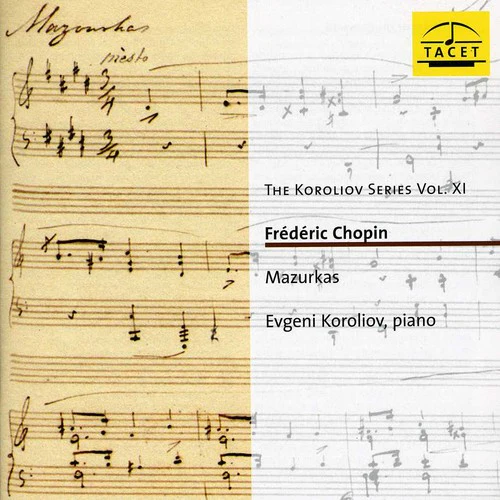
Chopin: Mazurkas / Evgeni Koroliov
A little less than half of Chopin’s complete surviving Mazurkas make up this 2009 release, ordered not according to opus number but for the purpose of an effective program that can sustain one’s interest for 80 minutes. The Mazurkas hold up under many different interpretive game plans, from Ignaz Friedman’s robust, epic statements to the perfumed intimacy of Maryla Jonas and Guiomar Novaes, not to mention Arthur Rubinstein’s three very different complete Mazurka cycles. Koroliov evokes Arturo Benedetti Michelangeli’s lapidarian finger work, wide dynamic range, and subjective poetry. You hear this in Op. 6 No. 1’s fastidious voicing of the central section’s leaps, although Michelangeli’s monumental left-hand droning fifths in Op. 56 No. 2 never lilted like Koroliov’s do here.
The pianist lends interest to the rather uneventful Op. 24 No. 1 by slightly accenting the dissonances, while his gentle way with the implicitly boisterous Op. 7 No. 1 is offset by striking phrase elongations and cross-rhythmic interplay in the deliciously modal Trio. Similarly, Op. 24 No. 2’s pared down outer sections contrast to the surprisingly rolled, loud A-flat major chords announcing its Trio. In fact, Koroliov is not averse to arpeggiating chords at will, or playing the left hand slightly before the right, dead pianist style, yet he employs these devices wisely. Deft polyphonic control justifies Koroliov’s admittedly pulled-about Op. 24 No. 4 and Op. 56 No. 3, while his mesmerizing legato control in the A minor “Émile Gaillard” Mazurka similarly convinces you that his unorthodox slow tempo is a plausible alternative.
Koroliov’s Chopin Mazurkas aren’t so much dances as distinct and diversified dramas, and he brings off his conceptions without a trace of ambiguity, whether or not you agree with the pianist’s every step. Tacet provides superb engineering and fulsome, high-handed annotations.
-- Jed Distler, ClassicsToday.com
The pianist lends interest to the rather uneventful Op. 24 No. 1 by slightly accenting the dissonances, while his gentle way with the implicitly boisterous Op. 7 No. 1 is offset by striking phrase elongations and cross-rhythmic interplay in the deliciously modal Trio. Similarly, Op. 24 No. 2’s pared down outer sections contrast to the surprisingly rolled, loud A-flat major chords announcing its Trio. In fact, Koroliov is not averse to arpeggiating chords at will, or playing the left hand slightly before the right, dead pianist style, yet he employs these devices wisely. Deft polyphonic control justifies Koroliov’s admittedly pulled-about Op. 24 No. 4 and Op. 56 No. 3, while his mesmerizing legato control in the A minor “Émile Gaillard” Mazurka similarly convinces you that his unorthodox slow tempo is a plausible alternative.
Koroliov’s Chopin Mazurkas aren’t so much dances as distinct and diversified dramas, and he brings off his conceptions without a trace of ambiguity, whether or not you agree with the pianist’s every step. Tacet provides superb engineering and fulsome, high-handed annotations.
-- Jed Distler, ClassicsToday.com
$23.99
Chopin: Mazurkas / Evgeni Koroliov—
$23.99
Product Information
Product Information
Shipping & Returns
Shipping & Returns
Description
A little less than half of Chopin’s complete surviving Mazurkas make up this 2009 release, ordered not according to opus number but for the purpose of an effective program that can sustain one’s interest for 80 minutes. The Mazurkas hold up under many different interpretive game plans, from Ignaz Friedman’s robust, epic statements to the perfumed intimacy of Maryla Jonas and Guiomar Novaes, not to mention Arthur Rubinstein’s three very different complete Mazurka cycles. Koroliov evokes Arturo Benedetti Michelangeli’s lapidarian finger work, wide dynamic range, and subjective poetry. You hear this in Op. 6 No. 1’s fastidious voicing of the central section’s leaps, although Michelangeli’s monumental left-hand droning fifths in Op. 56 No. 2 never lilted like Koroliov’s do here.
The pianist lends interest to the rather uneventful Op. 24 No. 1 by slightly accenting the dissonances, while his gentle way with the implicitly boisterous Op. 7 No. 1 is offset by striking phrase elongations and cross-rhythmic interplay in the deliciously modal Trio. Similarly, Op. 24 No. 2’s pared down outer sections contrast to the surprisingly rolled, loud A-flat major chords announcing its Trio. In fact, Koroliov is not averse to arpeggiating chords at will, or playing the left hand slightly before the right, dead pianist style, yet he employs these devices wisely. Deft polyphonic control justifies Koroliov’s admittedly pulled-about Op. 24 No. 4 and Op. 56 No. 3, while his mesmerizing legato control in the A minor “Émile Gaillard” Mazurka similarly convinces you that his unorthodox slow tempo is a plausible alternative.
Koroliov’s Chopin Mazurkas aren’t so much dances as distinct and diversified dramas, and he brings off his conceptions without a trace of ambiguity, whether or not you agree with the pianist’s every step. Tacet provides superb engineering and fulsome, high-handed annotations.
-- Jed Distler, ClassicsToday.com
The pianist lends interest to the rather uneventful Op. 24 No. 1 by slightly accenting the dissonances, while his gentle way with the implicitly boisterous Op. 7 No. 1 is offset by striking phrase elongations and cross-rhythmic interplay in the deliciously modal Trio. Similarly, Op. 24 No. 2’s pared down outer sections contrast to the surprisingly rolled, loud A-flat major chords announcing its Trio. In fact, Koroliov is not averse to arpeggiating chords at will, or playing the left hand slightly before the right, dead pianist style, yet he employs these devices wisely. Deft polyphonic control justifies Koroliov’s admittedly pulled-about Op. 24 No. 4 and Op. 56 No. 3, while his mesmerizing legato control in the A minor “Émile Gaillard” Mazurka similarly convinces you that his unorthodox slow tempo is a plausible alternative.
Koroliov’s Chopin Mazurkas aren’t so much dances as distinct and diversified dramas, and he brings off his conceptions without a trace of ambiguity, whether or not you agree with the pianist’s every step. Tacet provides superb engineering and fulsome, high-handed annotations.
-- Jed Distler, ClassicsToday.com