🚚 Free Worldwide Shipping on All Orders!Shop Now
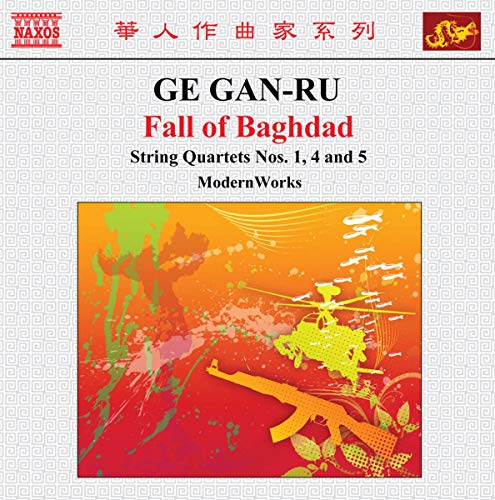
Chinese Classics - Ge Gan-Ru, Fall of Baghdad / Modern Works
GE GAN-RU String Quartets: No. 1, “Fu”; No. 4, “Angel Suite”; No. 5, “Fall of Baghdad” • ModernWorks • NAXOS 8.570603 (60:44)
Prior to this review I’d read a short profile of the composer in the Times , and discovered for a substantial period of time he’d dropped out of sight to found a business that now supports him and allows him freedom to compose as he wishes. As such, he may be the “Chinese Charles Ives.” Whatever the reason, these three string quartets show his evolution over that time gap, with No. 1 from 1983, and Nos. 4 and 5 from 1998 and 2007, respectively.
No. 1, “Fu” (Prose Poem), is in a single movement, and while it uses a number of special techniques for strings, the influence of middle-period Bartók is most evident, at least to my ear. This was radical music in context for a young Chinese composer, but not necessarily for the outside world. But No. 4, “Angel Suite,” is an exceedingly rich and original piece. In a way, it shouldn’t be, as it references the Western classical tradition most overtly, and indeed has a strong scent of the last fin de siècle. But though I hear Debussy very strongly throughout (above all in the first movement), its movements—including a dark waltz and similarly unsettling march—remain so full of interesting ideas and details that a strong personality cannot help but emerge. I found this music totally engaging, with a “postmodern” take that was never ironic, facile, or pastichesque.
No. 5 is subtitled “The Fall of Baghdad.” In its reference to destruction “in time of war,” it’s an homage to George Crumb’s 1970 Black Angels, and it opens with similarly wrenching, screeching sounds. The second movement features an extended, distant viola melody that recalls a muzzein’s call to prayer, which after an interlude of sinister rhythms using col legno and pizzicato, returns to the stratosphere. The third, “Desolation,” has a heartrending violin solo over pianissimo chords that suggest the classic “voice crying in the wilderness.” (No more so than when dark crunching sounds are ripped from behind the instruments’ bridges.) While the work starts out a little too reminiscent of its inspiration, like all the works on this program, Ge is in the details. It takes a little time, but a new, personal music emerges without any enormous technical or stylistic breakthrough; this is actually an enormous accomplishment. And lest I sound too technical, the music’s conclusion is shattering. We’ve got real art here.
ModernWorks is a string quartet directed by cellist Madeline Shapiro. (The other players are Airi Yoshioka and Majuki Fukuhara, violins, and Veronica Salas, viola.) They interpret this music brilliantly, and they have done great service to music by advocating this creator. I hope this recording finds a large audience, or at least the right audience. This composer has something to say, and staying power.
FANFARE: Robert Carl
Product Information
Product Information
Shipping & Returns
Shipping & Returns

Chinese Classics - Ge Gan-Ru, Fall of Baghdad / Modern Works
Chinese Classics - Ge Gan-Ru, Fall of Baghdad / Modern Works
GE GAN-RU String Quartets: No. 1, “Fu”; No. 4, “Angel Suite”; No. 5, “Fall of Baghdad” • ModernWorks • NAXOS 8.570603 (60:44)
Prior to this review I’d read a short profile of the composer in the Times , and discovered for a substantial period of time he’d dropped out of sight to found a business that now supports him and allows him freedom to compose as he wishes. As such, he may be the “Chinese Charles Ives.” Whatever the reason, these three string quartets show his evolution over that time gap, with No. 1 from 1983, and Nos. 4 and 5 from 1998 and 2007, respectively.
No. 1, “Fu” (Prose Poem), is in a single movement, and while it uses a number of special techniques for strings, the influence of middle-period Bartók is most evident, at least to my ear. This was radical music in context for a young Chinese composer, but not necessarily for the outside world. But No. 4, “Angel Suite,” is an exceedingly rich and original piece. In a way, it shouldn’t be, as it references the Western classical tradition most overtly, and indeed has a strong scent of the last fin de siècle. But though I hear Debussy very strongly throughout (above all in the first movement), its movements—including a dark waltz and similarly unsettling march—remain so full of interesting ideas and details that a strong personality cannot help but emerge. I found this music totally engaging, with a “postmodern” take that was never ironic, facile, or pastichesque.
No. 5 is subtitled “The Fall of Baghdad.” In its reference to destruction “in time of war,” it’s an homage to George Crumb’s 1970 Black Angels, and it opens with similarly wrenching, screeching sounds. The second movement features an extended, distant viola melody that recalls a muzzein’s call to prayer, which after an interlude of sinister rhythms using col legno and pizzicato, returns to the stratosphere. The third, “Desolation,” has a heartrending violin solo over pianissimo chords that suggest the classic “voice crying in the wilderness.” (No more so than when dark crunching sounds are ripped from behind the instruments’ bridges.) While the work starts out a little too reminiscent of its inspiration, like all the works on this program, Ge is in the details. It takes a little time, but a new, personal music emerges without any enormous technical or stylistic breakthrough; this is actually an enormous accomplishment. And lest I sound too technical, the music’s conclusion is shattering. We’ve got real art here.
ModernWorks is a string quartet directed by cellist Madeline Shapiro. (The other players are Airi Yoshioka and Majuki Fukuhara, violins, and Veronica Salas, viola.) They interpret this music brilliantly, and they have done great service to music by advocating this creator. I hope this recording finds a large audience, or at least the right audience. This composer has something to say, and staying power.
FANFARE: Robert Carl
$4.90
Original: $13.99
-65%Chinese Classics - Ge Gan-Ru, Fall of Baghdad / Modern Works—
$13.99
$4.90Product Information
Product Information
Shipping & Returns
Shipping & Returns
Description
GE GAN-RU String Quartets: No. 1, “Fu”; No. 4, “Angel Suite”; No. 5, “Fall of Baghdad” • ModernWorks • NAXOS 8.570603 (60:44)
Prior to this review I’d read a short profile of the composer in the Times , and discovered for a substantial period of time he’d dropped out of sight to found a business that now supports him and allows him freedom to compose as he wishes. As such, he may be the “Chinese Charles Ives.” Whatever the reason, these three string quartets show his evolution over that time gap, with No. 1 from 1983, and Nos. 4 and 5 from 1998 and 2007, respectively.
No. 1, “Fu” (Prose Poem), is in a single movement, and while it uses a number of special techniques for strings, the influence of middle-period Bartók is most evident, at least to my ear. This was radical music in context for a young Chinese composer, but not necessarily for the outside world. But No. 4, “Angel Suite,” is an exceedingly rich and original piece. In a way, it shouldn’t be, as it references the Western classical tradition most overtly, and indeed has a strong scent of the last fin de siècle. But though I hear Debussy very strongly throughout (above all in the first movement), its movements—including a dark waltz and similarly unsettling march—remain so full of interesting ideas and details that a strong personality cannot help but emerge. I found this music totally engaging, with a “postmodern” take that was never ironic, facile, or pastichesque.
No. 5 is subtitled “The Fall of Baghdad.” In its reference to destruction “in time of war,” it’s an homage to George Crumb’s 1970 Black Angels, and it opens with similarly wrenching, screeching sounds. The second movement features an extended, distant viola melody that recalls a muzzein’s call to prayer, which after an interlude of sinister rhythms using col legno and pizzicato, returns to the stratosphere. The third, “Desolation,” has a heartrending violin solo over pianissimo chords that suggest the classic “voice crying in the wilderness.” (No more so than when dark crunching sounds are ripped from behind the instruments’ bridges.) While the work starts out a little too reminiscent of its inspiration, like all the works on this program, Ge is in the details. It takes a little time, but a new, personal music emerges without any enormous technical or stylistic breakthrough; this is actually an enormous accomplishment. And lest I sound too technical, the music’s conclusion is shattering. We’ve got real art here.
ModernWorks is a string quartet directed by cellist Madeline Shapiro. (The other players are Airi Yoshioka and Majuki Fukuhara, violins, and Veronica Salas, viola.) They interpret this music brilliantly, and they have done great service to music by advocating this creator. I hope this recording finds a large audience, or at least the right audience. This composer has something to say, and staying power.
FANFARE: Robert Carl