🚚 Free Worldwide Shipping on All Orders!Shop Now
Caccini: Amarilli / Balconi, Fantazyas
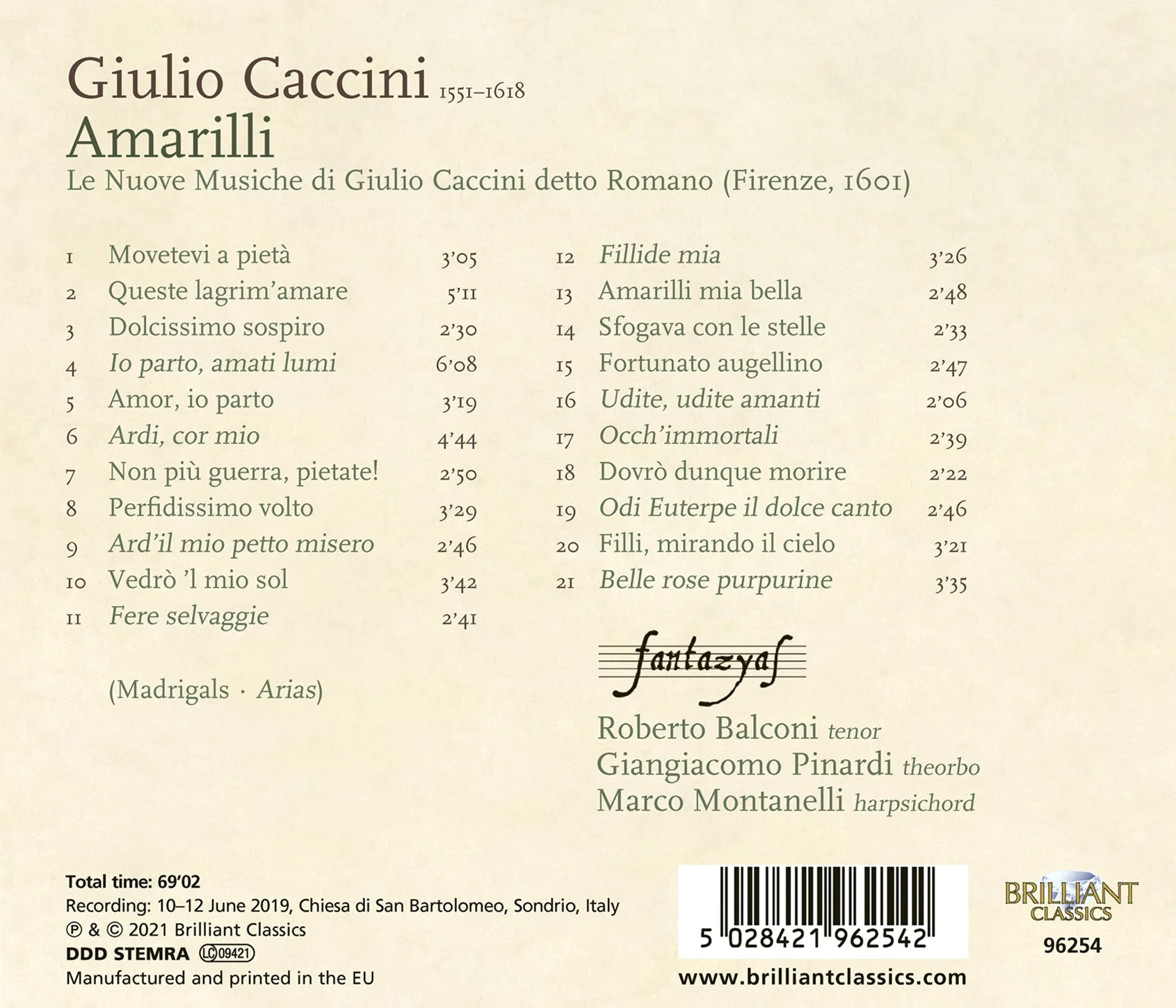
| In this expert recording, singer Roberto Balconi and group Fantasyas approach Giulio Caccini’s (1551-1618) Le Nuove Musiche with a focus on authentic performance practice as specified in great detail by the composer himself in the preface to the work. Dated 1601 and published in 1602, Le Nuove Musiche contains madrigals and arias for solo voice with basso continuo accompaniment and is a seminal collection in the establishment of the new Baroque style of monody which broke with Renaissance practices in many significant ways. In the preface, Caccini exhorts the performers to honour the primacy of speech and speech rhythm. Balconi explains: ‘Monody is more about words and metre than singing, focusing on the declamation of the semantic, rhetorical and prosodic elements of the poetic text rather than constructing a melody.’ This was a departure from the combined voices of Renaissance counterpoint, a move towards solo poetic recitation with the nuance of music in service of the meaning. Caccini lays out guidelines for the retrained and appropriate use of the improvised ornamentation that was the vogue in his day but which he considered too often gratuitous and overly virtuosic at the expense of the music. He stresses these should be used judiciously so that the singer can ‘almost speak in harmony’, in other words recite the text more or less normally using music. In adhering assiduously to Caccini’s compositional concept, Balconi and Fantazyas create an authentic and powerfully moving document of the birth of monody, which not only inspired the invention of opera but changed the entire course of music history. |
Product Information
Product Information
Shipping & Returns
Shipping & Returns

Caccini: Amarilli / Balconi, Fantazyas
Caccini: Amarilli / Balconi, Fantazyas
| In this expert recording, singer Roberto Balconi and group Fantasyas approach Giulio Caccini’s (1551-1618) Le Nuove Musiche with a focus on authentic performance practice as specified in great detail by the composer himself in the preface to the work. Dated 1601 and published in 1602, Le Nuove Musiche contains madrigals and arias for solo voice with basso continuo accompaniment and is a seminal collection in the establishment of the new Baroque style of monody which broke with Renaissance practices in many significant ways. In the preface, Caccini exhorts the performers to honour the primacy of speech and speech rhythm. Balconi explains: ‘Monody is more about words and metre than singing, focusing on the declamation of the semantic, rhetorical and prosodic elements of the poetic text rather than constructing a melody.’ This was a departure from the combined voices of Renaissance counterpoint, a move towards solo poetic recitation with the nuance of music in service of the meaning. Caccini lays out guidelines for the retrained and appropriate use of the improvised ornamentation that was the vogue in his day but which he considered too often gratuitous and overly virtuosic at the expense of the music. He stresses these should be used judiciously so that the singer can ‘almost speak in harmony’, in other words recite the text more or less normally using music. In adhering assiduously to Caccini’s compositional concept, Balconi and Fantazyas create an authentic and powerfully moving document of the birth of monody, which not only inspired the invention of opera but changed the entire course of music history. |
$4.90
Original: $13.99
-65%Caccini: Amarilli / Balconi, Fantazyas—
$13.99
$4.90Product Information
Product Information
Shipping & Returns
Shipping & Returns
Description
| In this expert recording, singer Roberto Balconi and group Fantasyas approach Giulio Caccini’s (1551-1618) Le Nuove Musiche with a focus on authentic performance practice as specified in great detail by the composer himself in the preface to the work. Dated 1601 and published in 1602, Le Nuove Musiche contains madrigals and arias for solo voice with basso continuo accompaniment and is a seminal collection in the establishment of the new Baroque style of monody which broke with Renaissance practices in many significant ways. In the preface, Caccini exhorts the performers to honour the primacy of speech and speech rhythm. Balconi explains: ‘Monody is more about words and metre than singing, focusing on the declamation of the semantic, rhetorical and prosodic elements of the poetic text rather than constructing a melody.’ This was a departure from the combined voices of Renaissance counterpoint, a move towards solo poetic recitation with the nuance of music in service of the meaning. Caccini lays out guidelines for the retrained and appropriate use of the improvised ornamentation that was the vogue in his day but which he considered too often gratuitous and overly virtuosic at the expense of the music. He stresses these should be used judiciously so that the singer can ‘almost speak in harmony’, in other words recite the text more or less normally using music. In adhering assiduously to Caccini’s compositional concept, Balconi and Fantazyas create an authentic and powerfully moving document of the birth of monody, which not only inspired the invention of opera but changed the entire course of music history. |