🚚 Free Worldwide Shipping on All Orders!Shop Now
C. P. E. Bach: Harpsichord Concertos / Belder, Musica Amphion

C.P.E. Bach’s keyboard concertos enjoy several fine performances on piano, but finding really top-notch interpretations on harpsichord until recently has proven elusive. For years he was best represented by Gustav Leonhardt’s version of the D minor concerto Wq 23, but this newcomer adds three more works to the still meager C.P.E. Bach concerto discography. Let’s start with the “orchestra”. I use the quotation marks because Musica Amphion consists of single strings–so, five players. They sound marvelous: big and bold in the tuttis, tellingly intimate and expressive in lyrical passages. Here is compelling evidence that string players on period instruments need not sacrifice all timbral beauty in pursuit of “authenticity”.
Pieter-Jan Belder has recorded lots of Bach before, including a fine set of C.P.E.’s Kenner und Liebhaber works. He’s a brilliant player with ample virtuoso chops for these technically demanding concertos. All three were composed in the 1730s and ’40s; that is, while J.S. Bach was very much alive and active, but they couldn’t sound more different. It’s a remarkable tribute to Emanuel’s independent voice that he was composing such characterful music at this early date; but then, consider who his teacher was and what an example he had to follow, even if his own personal style was quite different.
C.P.E. Bach is best known for his wild, passionate music in minor keys, and we have an excellent example of this in the G minor concerto Wq 6. Listen to the theme of its finale for a remarkable instance of something that still strikes us as uniquely intense and expressively powerful. However, Bach was just as interesting writing happy music in major keys. The finale of the E major concerto, one of only nine published in his lifetime–six of which belong to Wq 43–contains one of his catchiest tunes. However, like the early Concerto in G major Wq 3, the music is just as energetic, just as surprising, and just as compelling. This is just great stuff, and you owe it to yourself to savor these pieces.
-- David Hurwitz, ClassicsToday.com
Product Information
Product Information
Shipping & Returns
Shipping & Returns
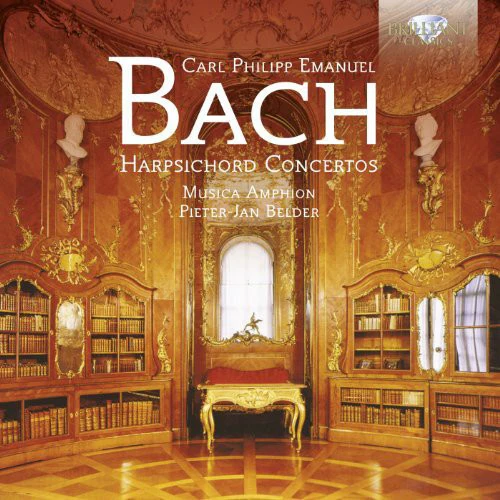
C. P. E. Bach: Harpsichord Concertos / Belder, Musica Amphion
C. P. E. Bach: Harpsichord Concertos / Belder, Musica Amphion
C.P.E. Bach’s keyboard concertos enjoy several fine performances on piano, but finding really top-notch interpretations on harpsichord until recently has proven elusive. For years he was best represented by Gustav Leonhardt’s version of the D minor concerto Wq 23, but this newcomer adds three more works to the still meager C.P.E. Bach concerto discography. Let’s start with the “orchestra”. I use the quotation marks because Musica Amphion consists of single strings–so, five players. They sound marvelous: big and bold in the tuttis, tellingly intimate and expressive in lyrical passages. Here is compelling evidence that string players on period instruments need not sacrifice all timbral beauty in pursuit of “authenticity”.
Pieter-Jan Belder has recorded lots of Bach before, including a fine set of C.P.E.’s Kenner und Liebhaber works. He’s a brilliant player with ample virtuoso chops for these technically demanding concertos. All three were composed in the 1730s and ’40s; that is, while J.S. Bach was very much alive and active, but they couldn’t sound more different. It’s a remarkable tribute to Emanuel’s independent voice that he was composing such characterful music at this early date; but then, consider who his teacher was and what an example he had to follow, even if his own personal style was quite different.
C.P.E. Bach is best known for his wild, passionate music in minor keys, and we have an excellent example of this in the G minor concerto Wq 6. Listen to the theme of its finale for a remarkable instance of something that still strikes us as uniquely intense and expressively powerful. However, Bach was just as interesting writing happy music in major keys. The finale of the E major concerto, one of only nine published in his lifetime–six of which belong to Wq 43–contains one of his catchiest tunes. However, like the early Concerto in G major Wq 3, the music is just as energetic, just as surprising, and just as compelling. This is just great stuff, and you owe it to yourself to savor these pieces.
-- David Hurwitz, ClassicsToday.com
$4.90
Original: $13.99
-65%C. P. E. Bach: Harpsichord Concertos / Belder, Musica Amphion—
$13.99
$4.90Product Information
Product Information
Shipping & Returns
Shipping & Returns
Description
C.P.E. Bach’s keyboard concertos enjoy several fine performances on piano, but finding really top-notch interpretations on harpsichord until recently has proven elusive. For years he was best represented by Gustav Leonhardt’s version of the D minor concerto Wq 23, but this newcomer adds three more works to the still meager C.P.E. Bach concerto discography. Let’s start with the “orchestra”. I use the quotation marks because Musica Amphion consists of single strings–so, five players. They sound marvelous: big and bold in the tuttis, tellingly intimate and expressive in lyrical passages. Here is compelling evidence that string players on period instruments need not sacrifice all timbral beauty in pursuit of “authenticity”.
Pieter-Jan Belder has recorded lots of Bach before, including a fine set of C.P.E.’s Kenner und Liebhaber works. He’s a brilliant player with ample virtuoso chops for these technically demanding concertos. All three were composed in the 1730s and ’40s; that is, while J.S. Bach was very much alive and active, but they couldn’t sound more different. It’s a remarkable tribute to Emanuel’s independent voice that he was composing such characterful music at this early date; but then, consider who his teacher was and what an example he had to follow, even if his own personal style was quite different.
C.P.E. Bach is best known for his wild, passionate music in minor keys, and we have an excellent example of this in the G minor concerto Wq 6. Listen to the theme of its finale for a remarkable instance of something that still strikes us as uniquely intense and expressively powerful. However, Bach was just as interesting writing happy music in major keys. The finale of the E major concerto, one of only nine published in his lifetime–six of which belong to Wq 43–contains one of his catchiest tunes. However, like the early Concerto in G major Wq 3, the music is just as energetic, just as surprising, and just as compelling. This is just great stuff, and you owe it to yourself to savor these pieces.
-- David Hurwitz, ClassicsToday.com