🚚 Free Worldwide Shipping on All Orders!Shop Now
Bruch: Scottish Fantasy, Serenade / Yablonsky, Et Al
When Heifetz chose Bruch’s Scottish Fantasy, reportedly his favorite concerto, for his legendary appearance on TV, he had already recorded it twice; the later recording, with Malcolm Sargent and the New Symphony Orchestra of London, has sometimes been recommended as representing him at his best. Although the Fantasy hasn’t received the attention that the First Concerto had garnered even in Bruch’s own lifetime (sometimes to his chagrin), its popularity seems to run ahead of the Second Concerto (which Heifetz also championed) and to outdistance by far the nearly orphaned Third, a chip of Spohr-like granite that remains the province of the few. Maxim Fedotov doesn’t challenge Heifetz’s proprietorship—or perhaps even Michael Rabin’s suave mastery, or even Kyung-Wha Chung’s passionate electricity; if his relaxed meandering in the opening movement and his weighty deliberation in the following Allegro don’t suggest fierce warlords (the Russian Philharmonic comes closer in the final movement, an Allegro guerriero), he plays with a rich, glowing tone that recalls Oistrakh’s, although perhaps not veiled with that master’s mystery, and his portamentos occasionally suggest an antique (if updated and sanitized) expressive manner well suited to this sentimental, though not maudlin, work. How did Pablo Sarasate, to whom Bruch dedicated it, play this concerto? He concocted his own confection from Scottish airs, so he must have had some familiarity with, and interest in, the folk idiom. The engineers haven’t shone the spotlight on Fedotov in the way Heifetz’s and Oistrakh’s did.
Bruch also dedicated his Serenade to Sarasate; and, though the Spaniard didn’t give its premiere, it bears the impress of his personality. If the Third Concerto seems a relative orphan, this work has remained almost unknown; but Salvatore Accardo included it in his collection of Bruch’s works for violin and orchestra with Kurt Masur and the Leipzig Gewandhaus Orchestra (originally on Philips 9500 590 and re-released on CD as Philips 289 462 167-2). While Accardo’s reading explored the work’s nostalgic sensibility, Fedotov’s takes a more muscular approach to its tangy, concerto-like virtuosity—Bruch had, after all, intended this work as a concerto-like serenade (he repeatedly wrote movements and works that he expected would turn out to be his Fourth Concerto—without losing touch with its brooding sensitivity. His tempos seem relatively leisurely in the opening movement and upon its return at the Serenade’s end (in an effective valedictory gesture, Yablonsky and the orchestra insinuate the Serenade’s returning opening materials with poignant subtlety and close with a serenely hushed cadence), as well as in the episodic passages of the fast movements; but he struts briskly, too, as in the second movement’s march. Perhaps decisively, though, he doesn’t seem quite so comfortable in the long second movement as Accardo did, and he wanders without a strong sense of direction—though with richly textured symphonic support—in the sprawling third.
Those hoping to explore Bruch œuvre at first cautiously, then with more abandon, should find the Fantasy and the Serenade a well-ordered program. Recommended as a digitally recorded alternative to Accardo’s readings.
Robert Maxham, FANFARE
Bruch also dedicated his Serenade to Sarasate; and, though the Spaniard didn’t give its premiere, it bears the impress of his personality. If the Third Concerto seems a relative orphan, this work has remained almost unknown; but Salvatore Accardo included it in his collection of Bruch’s works for violin and orchestra with Kurt Masur and the Leipzig Gewandhaus Orchestra (originally on Philips 9500 590 and re-released on CD as Philips 289 462 167-2). While Accardo’s reading explored the work’s nostalgic sensibility, Fedotov’s takes a more muscular approach to its tangy, concerto-like virtuosity—Bruch had, after all, intended this work as a concerto-like serenade (he repeatedly wrote movements and works that he expected would turn out to be his Fourth Concerto—without losing touch with its brooding sensitivity. His tempos seem relatively leisurely in the opening movement and upon its return at the Serenade’s end (in an effective valedictory gesture, Yablonsky and the orchestra insinuate the Serenade’s returning opening materials with poignant subtlety and close with a serenely hushed cadence), as well as in the episodic passages of the fast movements; but he struts briskly, too, as in the second movement’s march. Perhaps decisively, though, he doesn’t seem quite so comfortable in the long second movement as Accardo did, and he wanders without a strong sense of direction—though with richly textured symphonic support—in the sprawling third.
Those hoping to explore Bruch œuvre at first cautiously, then with more abandon, should find the Fantasy and the Serenade a well-ordered program. Recommended as a digitally recorded alternative to Accardo’s readings.
Robert Maxham, FANFARE
Product Information
Product Information
Shipping & Returns
Shipping & Returns
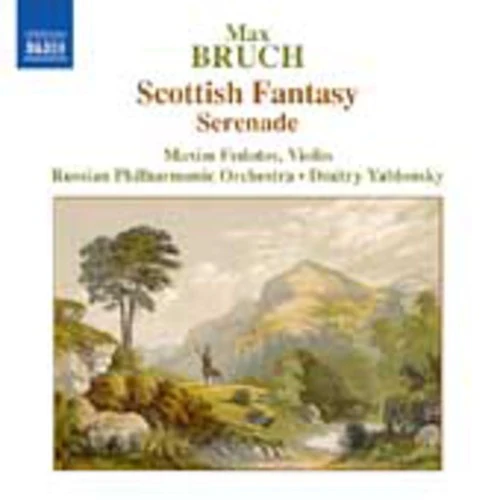
Bruch: Scottish Fantasy, Serenade / Yablonsky, Et Al
Bruch: Scottish Fantasy, Serenade / Yablonsky, Et Al
When Heifetz chose Bruch’s Scottish Fantasy, reportedly his favorite concerto, for his legendary appearance on TV, he had already recorded it twice; the later recording, with Malcolm Sargent and the New Symphony Orchestra of London, has sometimes been recommended as representing him at his best. Although the Fantasy hasn’t received the attention that the First Concerto had garnered even in Bruch’s own lifetime (sometimes to his chagrin), its popularity seems to run ahead of the Second Concerto (which Heifetz also championed) and to outdistance by far the nearly orphaned Third, a chip of Spohr-like granite that remains the province of the few. Maxim Fedotov doesn’t challenge Heifetz’s proprietorship—or perhaps even Michael Rabin’s suave mastery, or even Kyung-Wha Chung’s passionate electricity; if his relaxed meandering in the opening movement and his weighty deliberation in the following Allegro don’t suggest fierce warlords (the Russian Philharmonic comes closer in the final movement, an Allegro guerriero), he plays with a rich, glowing tone that recalls Oistrakh’s, although perhaps not veiled with that master’s mystery, and his portamentos occasionally suggest an antique (if updated and sanitized) expressive manner well suited to this sentimental, though not maudlin, work. How did Pablo Sarasate, to whom Bruch dedicated it, play this concerto? He concocted his own confection from Scottish airs, so he must have had some familiarity with, and interest in, the folk idiom. The engineers haven’t shone the spotlight on Fedotov in the way Heifetz’s and Oistrakh’s did.
Bruch also dedicated his Serenade to Sarasate; and, though the Spaniard didn’t give its premiere, it bears the impress of his personality. If the Third Concerto seems a relative orphan, this work has remained almost unknown; but Salvatore Accardo included it in his collection of Bruch’s works for violin and orchestra with Kurt Masur and the Leipzig Gewandhaus Orchestra (originally on Philips 9500 590 and re-released on CD as Philips 289 462 167-2). While Accardo’s reading explored the work’s nostalgic sensibility, Fedotov’s takes a more muscular approach to its tangy, concerto-like virtuosity—Bruch had, after all, intended this work as a concerto-like serenade (he repeatedly wrote movements and works that he expected would turn out to be his Fourth Concerto—without losing touch with its brooding sensitivity. His tempos seem relatively leisurely in the opening movement and upon its return at the Serenade’s end (in an effective valedictory gesture, Yablonsky and the orchestra insinuate the Serenade’s returning opening materials with poignant subtlety and close with a serenely hushed cadence), as well as in the episodic passages of the fast movements; but he struts briskly, too, as in the second movement’s march. Perhaps decisively, though, he doesn’t seem quite so comfortable in the long second movement as Accardo did, and he wanders without a strong sense of direction—though with richly textured symphonic support—in the sprawling third.
Those hoping to explore Bruch œuvre at first cautiously, then with more abandon, should find the Fantasy and the Serenade a well-ordered program. Recommended as a digitally recorded alternative to Accardo’s readings.
Robert Maxham, FANFARE
Bruch also dedicated his Serenade to Sarasate; and, though the Spaniard didn’t give its premiere, it bears the impress of his personality. If the Third Concerto seems a relative orphan, this work has remained almost unknown; but Salvatore Accardo included it in his collection of Bruch’s works for violin and orchestra with Kurt Masur and the Leipzig Gewandhaus Orchestra (originally on Philips 9500 590 and re-released on CD as Philips 289 462 167-2). While Accardo’s reading explored the work’s nostalgic sensibility, Fedotov’s takes a more muscular approach to its tangy, concerto-like virtuosity—Bruch had, after all, intended this work as a concerto-like serenade (he repeatedly wrote movements and works that he expected would turn out to be his Fourth Concerto—without losing touch with its brooding sensitivity. His tempos seem relatively leisurely in the opening movement and upon its return at the Serenade’s end (in an effective valedictory gesture, Yablonsky and the orchestra insinuate the Serenade’s returning opening materials with poignant subtlety and close with a serenely hushed cadence), as well as in the episodic passages of the fast movements; but he struts briskly, too, as in the second movement’s march. Perhaps decisively, though, he doesn’t seem quite so comfortable in the long second movement as Accardo did, and he wanders without a strong sense of direction—though with richly textured symphonic support—in the sprawling third.
Those hoping to explore Bruch œuvre at first cautiously, then with more abandon, should find the Fantasy and the Serenade a well-ordered program. Recommended as a digitally recorded alternative to Accardo’s readings.
Robert Maxham, FANFARE
$19.99
Bruch: Scottish Fantasy, Serenade / Yablonsky, Et Al—
$19.99
Product Information
Product Information
Shipping & Returns
Shipping & Returns
Description
When Heifetz chose Bruch’s Scottish Fantasy, reportedly his favorite concerto, for his legendary appearance on TV, he had already recorded it twice; the later recording, with Malcolm Sargent and the New Symphony Orchestra of London, has sometimes been recommended as representing him at his best. Although the Fantasy hasn’t received the attention that the First Concerto had garnered even in Bruch’s own lifetime (sometimes to his chagrin), its popularity seems to run ahead of the Second Concerto (which Heifetz also championed) and to outdistance by far the nearly orphaned Third, a chip of Spohr-like granite that remains the province of the few. Maxim Fedotov doesn’t challenge Heifetz’s proprietorship—or perhaps even Michael Rabin’s suave mastery, or even Kyung-Wha Chung’s passionate electricity; if his relaxed meandering in the opening movement and his weighty deliberation in the following Allegro don’t suggest fierce warlords (the Russian Philharmonic comes closer in the final movement, an Allegro guerriero), he plays with a rich, glowing tone that recalls Oistrakh’s, although perhaps not veiled with that master’s mystery, and his portamentos occasionally suggest an antique (if updated and sanitized) expressive manner well suited to this sentimental, though not maudlin, work. How did Pablo Sarasate, to whom Bruch dedicated it, play this concerto? He concocted his own confection from Scottish airs, so he must have had some familiarity with, and interest in, the folk idiom. The engineers haven’t shone the spotlight on Fedotov in the way Heifetz’s and Oistrakh’s did.
Bruch also dedicated his Serenade to Sarasate; and, though the Spaniard didn’t give its premiere, it bears the impress of his personality. If the Third Concerto seems a relative orphan, this work has remained almost unknown; but Salvatore Accardo included it in his collection of Bruch’s works for violin and orchestra with Kurt Masur and the Leipzig Gewandhaus Orchestra (originally on Philips 9500 590 and re-released on CD as Philips 289 462 167-2). While Accardo’s reading explored the work’s nostalgic sensibility, Fedotov’s takes a more muscular approach to its tangy, concerto-like virtuosity—Bruch had, after all, intended this work as a concerto-like serenade (he repeatedly wrote movements and works that he expected would turn out to be his Fourth Concerto—without losing touch with its brooding sensitivity. His tempos seem relatively leisurely in the opening movement and upon its return at the Serenade’s end (in an effective valedictory gesture, Yablonsky and the orchestra insinuate the Serenade’s returning opening materials with poignant subtlety and close with a serenely hushed cadence), as well as in the episodic passages of the fast movements; but he struts briskly, too, as in the second movement’s march. Perhaps decisively, though, he doesn’t seem quite so comfortable in the long second movement as Accardo did, and he wanders without a strong sense of direction—though with richly textured symphonic support—in the sprawling third.
Those hoping to explore Bruch œuvre at first cautiously, then with more abandon, should find the Fantasy and the Serenade a well-ordered program. Recommended as a digitally recorded alternative to Accardo’s readings.
Robert Maxham, FANFARE
Bruch also dedicated his Serenade to Sarasate; and, though the Spaniard didn’t give its premiere, it bears the impress of his personality. If the Third Concerto seems a relative orphan, this work has remained almost unknown; but Salvatore Accardo included it in his collection of Bruch’s works for violin and orchestra with Kurt Masur and the Leipzig Gewandhaus Orchestra (originally on Philips 9500 590 and re-released on CD as Philips 289 462 167-2). While Accardo’s reading explored the work’s nostalgic sensibility, Fedotov’s takes a more muscular approach to its tangy, concerto-like virtuosity—Bruch had, after all, intended this work as a concerto-like serenade (he repeatedly wrote movements and works that he expected would turn out to be his Fourth Concerto—without losing touch with its brooding sensitivity. His tempos seem relatively leisurely in the opening movement and upon its return at the Serenade’s end (in an effective valedictory gesture, Yablonsky and the orchestra insinuate the Serenade’s returning opening materials with poignant subtlety and close with a serenely hushed cadence), as well as in the episodic passages of the fast movements; but he struts briskly, too, as in the second movement’s march. Perhaps decisively, though, he doesn’t seem quite so comfortable in the long second movement as Accardo did, and he wanders without a strong sense of direction—though with richly textured symphonic support—in the sprawling third.
Those hoping to explore Bruch œuvre at first cautiously, then with more abandon, should find the Fantasy and the Serenade a well-ordered program. Recommended as a digitally recorded alternative to Accardo’s readings.
Robert Maxham, FANFARE