🚚 Free Worldwide Shipping on All Orders!Shop Now
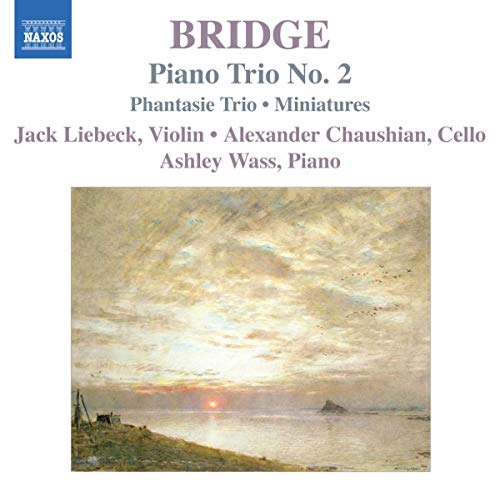
Bridge: Piano Trio No 2, Phantasie Trio, Miniatures / Wass, Liebeck, Chaushian
BRIDGE Piano Trios: No. 1, “Phantasie”; No. 2. Miniatures: Set 1; Set 2; Set 3 • Ashley Wass (pn); Jack Liebeck (vn); Alexander Chaushian (vc) • NAXOS 8.570792 (72:47)
The half-hour Bridge Second Trio (1929) is one of the best things he ever wrote, some of the very strongest British chamber music of its time, along with Bridge’s own last two quartets. The opening is unforgettably bleak, and a ripe expressionist drama unfolds. It is not as “advanced” as the music Webern and Schoenberg were writing 20 years earlier, yet at the same time it almost prefigures Shostakovich. Sound here is very good, and the playing has great commitment, concentration, and fleetness of foot. But the very stiff competition includes a live 1963 version with Britten, Menuhin, and Gendron, as well as a fine, cheap Helios disc.
Compared to the Trio No. 2, the rest of the CD offers salon music. The “Phantasie” Trio is much like the other Cobbett Prize-winning pieces by various composers, and it sounds faded to my ears, though these players give it everything. The Miniatures are slight character studies in late-19th century style, but they may be the disc’s main selling point for Bridge collectors. The Dussek Trio’s 1995 version is good, but these Naxos players make a strong case for the Miniatures , and the sound is better. This performance of the Second Trio won’t disappoint you either, if you get the Naxos disc for the other repertoire; though if you already have the Lyrita or Helios recordings, rest easy. If you have no Bridge Second Trio, do get the Britten version on BBC, even if you buy none of the other CDs. The new disc is highly recommended to admirers of the composer—two different composers, really, early and late, as this CD vividly demonstrates.
FANFARE: Paul Ingram
Product Information
Product Information
Shipping & Returns
Shipping & Returns

Bridge: Piano Trio No 2, Phantasie Trio, Miniatures / Wass, Liebeck, Chaushian
Bridge: Piano Trio No 2, Phantasie Trio, Miniatures / Wass, Liebeck, Chaushian
BRIDGE Piano Trios: No. 1, “Phantasie”; No. 2. Miniatures: Set 1; Set 2; Set 3 • Ashley Wass (pn); Jack Liebeck (vn); Alexander Chaushian (vc) • NAXOS 8.570792 (72:47)
The half-hour Bridge Second Trio (1929) is one of the best things he ever wrote, some of the very strongest British chamber music of its time, along with Bridge’s own last two quartets. The opening is unforgettably bleak, and a ripe expressionist drama unfolds. It is not as “advanced” as the music Webern and Schoenberg were writing 20 years earlier, yet at the same time it almost prefigures Shostakovich. Sound here is very good, and the playing has great commitment, concentration, and fleetness of foot. But the very stiff competition includes a live 1963 version with Britten, Menuhin, and Gendron, as well as a fine, cheap Helios disc.
Compared to the Trio No. 2, the rest of the CD offers salon music. The “Phantasie” Trio is much like the other Cobbett Prize-winning pieces by various composers, and it sounds faded to my ears, though these players give it everything. The Miniatures are slight character studies in late-19th century style, but they may be the disc’s main selling point for Bridge collectors. The Dussek Trio’s 1995 version is good, but these Naxos players make a strong case for the Miniatures , and the sound is better. This performance of the Second Trio won’t disappoint you either, if you get the Naxos disc for the other repertoire; though if you already have the Lyrita or Helios recordings, rest easy. If you have no Bridge Second Trio, do get the Britten version on BBC, even if you buy none of the other CDs. The new disc is highly recommended to admirers of the composer—two different composers, really, early and late, as this CD vividly demonstrates.
FANFARE: Paul Ingram
$13.99
Bridge: Piano Trio No 2, Phantasie Trio, Miniatures / Wass, Liebeck, Chaushian—
$13.99
Product Information
Product Information
Shipping & Returns
Shipping & Returns
Description
BRIDGE Piano Trios: No. 1, “Phantasie”; No. 2. Miniatures: Set 1; Set 2; Set 3 • Ashley Wass (pn); Jack Liebeck (vn); Alexander Chaushian (vc) • NAXOS 8.570792 (72:47)
The half-hour Bridge Second Trio (1929) is one of the best things he ever wrote, some of the very strongest British chamber music of its time, along with Bridge’s own last two quartets. The opening is unforgettably bleak, and a ripe expressionist drama unfolds. It is not as “advanced” as the music Webern and Schoenberg were writing 20 years earlier, yet at the same time it almost prefigures Shostakovich. Sound here is very good, and the playing has great commitment, concentration, and fleetness of foot. But the very stiff competition includes a live 1963 version with Britten, Menuhin, and Gendron, as well as a fine, cheap Helios disc.
Compared to the Trio No. 2, the rest of the CD offers salon music. The “Phantasie” Trio is much like the other Cobbett Prize-winning pieces by various composers, and it sounds faded to my ears, though these players give it everything. The Miniatures are slight character studies in late-19th century style, but they may be the disc’s main selling point for Bridge collectors. The Dussek Trio’s 1995 version is good, but these Naxos players make a strong case for the Miniatures , and the sound is better. This performance of the Second Trio won’t disappoint you either, if you get the Naxos disc for the other repertoire; though if you already have the Lyrita or Helios recordings, rest easy. If you have no Bridge Second Trio, do get the Britten version on BBC, even if you buy none of the other CDs. The new disc is highly recommended to admirers of the composer—two different composers, really, early and late, as this CD vividly demonstrates.
FANFARE: Paul Ingram