🚚 Free Worldwide Shipping on All Orders!Shop Now
Bach: Sonatas For Flute / Rampal, Pinnock, Pidoux
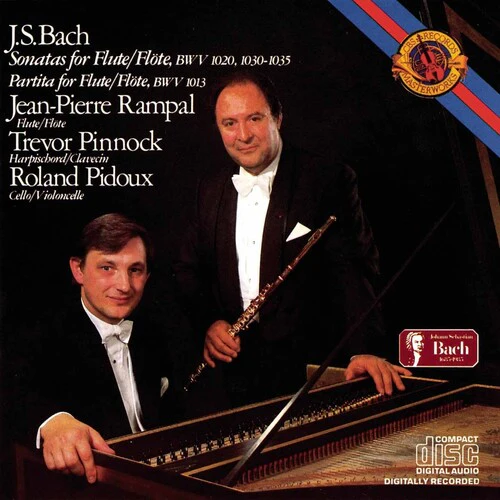
Whilst there have been many recordings of Bach's flute sonatas there has been less than total agreement as to what should (and should not) be included under that heading; Cologne Musica Antiqua with Wilbert Hazelzet (in a seven record set—DG 2742 007, 1/84), otherwise frontrunners, present BWVIO2O as a violin work. Our comparison is thus between artists, performances and instruments—Hünteler on Philips uses a single-key, period (reproduction) flute but Rampal is here shown holding a metal flute with 'all mod.' keywork, two very different instruments indeed.
Johnny Dankworth once described his own music as "couth, kempt and shevelled" and Rampal's performances, those of a consummate technician, strike me in the same way. Commendably, he avoids using his facility to indulge in fast tempos; where his striking rate is the higher, as in BWVI030/1II and BWVI032/11I, it is rather that Hünteler is leisurely—and occasionally the situation is inverted, e.g. in BWV l035/I. The baroque flute is an intimate, 'vocally' flexible instrument with a softer-edged attack than today's instrument, capable of much subtelty of nuance in volume, tone and pitch. Lines of separately attacked notes, particularly in BWVI032/1, III and BWV 1035/li, sound more typewriter-like from Rampal, but, strangely, it is Hünteler who respects the detaché markings at the opening of BWV 1035/Ill, not Rampal. The slow movements point the difference in approach (and instrument), Hünteler shaping the lines affectionately, leaning on the appoggiaturas and often scarcely breathing their resolutions, and Rampal more inclined to deliver his lines smoothly and more evenly—the beauty of purity. Rampal ventures some embellishment, notably in BWVI030/I1 and BWV1033/ III, and does so stylishly, but not in the famous Siciliana (BWV 1031/11)—where H Onteler's little flights of fancy are matched by Koopman's. I am not convinced by some of the interruptions in Rampal's lines, especially those which fragment the opening section of the unaccompanied Partita, BWV tO 13, surely not imposed by breathing 'strategy'. The completion of BWV1032/I is by Pinnock and seems as good as anyone else's. Though more reserved in his approach, Pinnock is as good a partner as Rampal could have wished for and he seems as much at home (though not always so balanced in sound) as he does with Stephen Preston (CRD CRDI0I4/5, 8/75), a set which, however, lacks BWV 1020.
In short, this is a thoughtful, cultured and pleasing set, well recorded and on the whole nicely balanced, but lacking in emotional involvement; the beauty of the music often seems admired rather than loved. Though the baroque flute is clearly the best horse for this course, this is the best-yet Set recorded on today's instrument—and very recommendable to those who prefer its sound.
-- J.D., Gramophone [ 12/1985]
Johnny Dankworth once described his own music as "couth, kempt and shevelled" and Rampal's performances, those of a consummate technician, strike me in the same way. Commendably, he avoids using his facility to indulge in fast tempos; where his striking rate is the higher, as in BWVI030/1II and BWVI032/11I, it is rather that Hünteler is leisurely—and occasionally the situation is inverted, e.g. in BWV l035/I. The baroque flute is an intimate, 'vocally' flexible instrument with a softer-edged attack than today's instrument, capable of much subtelty of nuance in volume, tone and pitch. Lines of separately attacked notes, particularly in BWVI032/1, III and BWV 1035/li, sound more typewriter-like from Rampal, but, strangely, it is Hünteler who respects the detaché markings at the opening of BWV 1035/Ill, not Rampal. The slow movements point the difference in approach (and instrument), Hünteler shaping the lines affectionately, leaning on the appoggiaturas and often scarcely breathing their resolutions, and Rampal more inclined to deliver his lines smoothly and more evenly—the beauty of purity. Rampal ventures some embellishment, notably in BWVI030/I1 and BWV1033/ III, and does so stylishly, but not in the famous Siciliana (BWV 1031/11)—where H Onteler's little flights of fancy are matched by Koopman's. I am not convinced by some of the interruptions in Rampal's lines, especially those which fragment the opening section of the unaccompanied Partita, BWV tO 13, surely not imposed by breathing 'strategy'. The completion of BWV1032/I is by Pinnock and seems as good as anyone else's. Though more reserved in his approach, Pinnock is as good a partner as Rampal could have wished for and he seems as much at home (though not always so balanced in sound) as he does with Stephen Preston (CRD CRDI0I4/5, 8/75), a set which, however, lacks BWV 1020.
In short, this is a thoughtful, cultured and pleasing set, well recorded and on the whole nicely balanced, but lacking in emotional involvement; the beauty of the music often seems admired rather than loved. Though the baroque flute is clearly the best horse for this course, this is the best-yet Set recorded on today's instrument—and very recommendable to those who prefer its sound.
-- J.D., Gramophone [ 12/1985]
Product Information
Product Information
Shipping & Returns
Shipping & Returns
Bach: Sonatas For Flute / Rampal, Pinnock, Pidoux
Bach: Sonatas For Flute / Rampal, Pinnock, Pidoux
Whilst there have been many recordings of Bach's flute sonatas there has been less than total agreement as to what should (and should not) be included under that heading; Cologne Musica Antiqua with Wilbert Hazelzet (in a seven record set—DG 2742 007, 1/84), otherwise frontrunners, present BWVIO2O as a violin work. Our comparison is thus between artists, performances and instruments—Hünteler on Philips uses a single-key, period (reproduction) flute but Rampal is here shown holding a metal flute with 'all mod.' keywork, two very different instruments indeed.
Johnny Dankworth once described his own music as "couth, kempt and shevelled" and Rampal's performances, those of a consummate technician, strike me in the same way. Commendably, he avoids using his facility to indulge in fast tempos; where his striking rate is the higher, as in BWVI030/1II and BWVI032/11I, it is rather that Hünteler is leisurely—and occasionally the situation is inverted, e.g. in BWV l035/I. The baroque flute is an intimate, 'vocally' flexible instrument with a softer-edged attack than today's instrument, capable of much subtelty of nuance in volume, tone and pitch. Lines of separately attacked notes, particularly in BWVI032/1, III and BWV 1035/li, sound more typewriter-like from Rampal, but, strangely, it is Hünteler who respects the detaché markings at the opening of BWV 1035/Ill, not Rampal. The slow movements point the difference in approach (and instrument), Hünteler shaping the lines affectionately, leaning on the appoggiaturas and often scarcely breathing their resolutions, and Rampal more inclined to deliver his lines smoothly and more evenly—the beauty of purity. Rampal ventures some embellishment, notably in BWVI030/I1 and BWV1033/ III, and does so stylishly, but not in the famous Siciliana (BWV 1031/11)—where H Onteler's little flights of fancy are matched by Koopman's. I am not convinced by some of the interruptions in Rampal's lines, especially those which fragment the opening section of the unaccompanied Partita, BWV tO 13, surely not imposed by breathing 'strategy'. The completion of BWV1032/I is by Pinnock and seems as good as anyone else's. Though more reserved in his approach, Pinnock is as good a partner as Rampal could have wished for and he seems as much at home (though not always so balanced in sound) as he does with Stephen Preston (CRD CRDI0I4/5, 8/75), a set which, however, lacks BWV 1020.
In short, this is a thoughtful, cultured and pleasing set, well recorded and on the whole nicely balanced, but lacking in emotional involvement; the beauty of the music often seems admired rather than loved. Though the baroque flute is clearly the best horse for this course, this is the best-yet Set recorded on today's instrument—and very recommendable to those who prefer its sound.
-- J.D., Gramophone [ 12/1985]
Johnny Dankworth once described his own music as "couth, kempt and shevelled" and Rampal's performances, those of a consummate technician, strike me in the same way. Commendably, he avoids using his facility to indulge in fast tempos; where his striking rate is the higher, as in BWVI030/1II and BWVI032/11I, it is rather that Hünteler is leisurely—and occasionally the situation is inverted, e.g. in BWV l035/I. The baroque flute is an intimate, 'vocally' flexible instrument with a softer-edged attack than today's instrument, capable of much subtelty of nuance in volume, tone and pitch. Lines of separately attacked notes, particularly in BWVI032/1, III and BWV 1035/li, sound more typewriter-like from Rampal, but, strangely, it is Hünteler who respects the detaché markings at the opening of BWV 1035/Ill, not Rampal. The slow movements point the difference in approach (and instrument), Hünteler shaping the lines affectionately, leaning on the appoggiaturas and often scarcely breathing their resolutions, and Rampal more inclined to deliver his lines smoothly and more evenly—the beauty of purity. Rampal ventures some embellishment, notably in BWVI030/I1 and BWV1033/ III, and does so stylishly, but not in the famous Siciliana (BWV 1031/11)—where H Onteler's little flights of fancy are matched by Koopman's. I am not convinced by some of the interruptions in Rampal's lines, especially those which fragment the opening section of the unaccompanied Partita, BWV tO 13, surely not imposed by breathing 'strategy'. The completion of BWV1032/I is by Pinnock and seems as good as anyone else's. Though more reserved in his approach, Pinnock is as good a partner as Rampal could have wished for and he seems as much at home (though not always so balanced in sound) as he does with Stephen Preston (CRD CRDI0I4/5, 8/75), a set which, however, lacks BWV 1020.
In short, this is a thoughtful, cultured and pleasing set, well recorded and on the whole nicely balanced, but lacking in emotional involvement; the beauty of the music often seems admired rather than loved. Though the baroque flute is clearly the best horse for this course, this is the best-yet Set recorded on today's instrument—and very recommendable to those who prefer its sound.
-- J.D., Gramophone [ 12/1985]
$8.75
Original: $24.99
-65%Bach: Sonatas For Flute / Rampal, Pinnock, Pidoux—
$24.99
$8.75Product Information
Product Information
Shipping & Returns
Shipping & Returns
Description
Whilst there have been many recordings of Bach's flute sonatas there has been less than total agreement as to what should (and should not) be included under that heading; Cologne Musica Antiqua with Wilbert Hazelzet (in a seven record set—DG 2742 007, 1/84), otherwise frontrunners, present BWVIO2O as a violin work. Our comparison is thus between artists, performances and instruments—Hünteler on Philips uses a single-key, period (reproduction) flute but Rampal is here shown holding a metal flute with 'all mod.' keywork, two very different instruments indeed.
Johnny Dankworth once described his own music as "couth, kempt and shevelled" and Rampal's performances, those of a consummate technician, strike me in the same way. Commendably, he avoids using his facility to indulge in fast tempos; where his striking rate is the higher, as in BWVI030/1II and BWVI032/11I, it is rather that Hünteler is leisurely—and occasionally the situation is inverted, e.g. in BWV l035/I. The baroque flute is an intimate, 'vocally' flexible instrument with a softer-edged attack than today's instrument, capable of much subtelty of nuance in volume, tone and pitch. Lines of separately attacked notes, particularly in BWVI032/1, III and BWV 1035/li, sound more typewriter-like from Rampal, but, strangely, it is Hünteler who respects the detaché markings at the opening of BWV 1035/Ill, not Rampal. The slow movements point the difference in approach (and instrument), Hünteler shaping the lines affectionately, leaning on the appoggiaturas and often scarcely breathing their resolutions, and Rampal more inclined to deliver his lines smoothly and more evenly—the beauty of purity. Rampal ventures some embellishment, notably in BWVI030/I1 and BWV1033/ III, and does so stylishly, but not in the famous Siciliana (BWV 1031/11)—where H Onteler's little flights of fancy are matched by Koopman's. I am not convinced by some of the interruptions in Rampal's lines, especially those which fragment the opening section of the unaccompanied Partita, BWV tO 13, surely not imposed by breathing 'strategy'. The completion of BWV1032/I is by Pinnock and seems as good as anyone else's. Though more reserved in his approach, Pinnock is as good a partner as Rampal could have wished for and he seems as much at home (though not always so balanced in sound) as he does with Stephen Preston (CRD CRDI0I4/5, 8/75), a set which, however, lacks BWV 1020.
In short, this is a thoughtful, cultured and pleasing set, well recorded and on the whole nicely balanced, but lacking in emotional involvement; the beauty of the music often seems admired rather than loved. Though the baroque flute is clearly the best horse for this course, this is the best-yet Set recorded on today's instrument—and very recommendable to those who prefer its sound.
-- J.D., Gramophone [ 12/1985]
Johnny Dankworth once described his own music as "couth, kempt and shevelled" and Rampal's performances, those of a consummate technician, strike me in the same way. Commendably, he avoids using his facility to indulge in fast tempos; where his striking rate is the higher, as in BWVI030/1II and BWVI032/11I, it is rather that Hünteler is leisurely—and occasionally the situation is inverted, e.g. in BWV l035/I. The baroque flute is an intimate, 'vocally' flexible instrument with a softer-edged attack than today's instrument, capable of much subtelty of nuance in volume, tone and pitch. Lines of separately attacked notes, particularly in BWVI032/1, III and BWV 1035/li, sound more typewriter-like from Rampal, but, strangely, it is Hünteler who respects the detaché markings at the opening of BWV 1035/Ill, not Rampal. The slow movements point the difference in approach (and instrument), Hünteler shaping the lines affectionately, leaning on the appoggiaturas and often scarcely breathing their resolutions, and Rampal more inclined to deliver his lines smoothly and more evenly—the beauty of purity. Rampal ventures some embellishment, notably in BWVI030/I1 and BWV1033/ III, and does so stylishly, but not in the famous Siciliana (BWV 1031/11)—where H Onteler's little flights of fancy are matched by Koopman's. I am not convinced by some of the interruptions in Rampal's lines, especially those which fragment the opening section of the unaccompanied Partita, BWV tO 13, surely not imposed by breathing 'strategy'. The completion of BWV1032/I is by Pinnock and seems as good as anyone else's. Though more reserved in his approach, Pinnock is as good a partner as Rampal could have wished for and he seems as much at home (though not always so balanced in sound) as he does with Stephen Preston (CRD CRDI0I4/5, 8/75), a set which, however, lacks BWV 1020.
In short, this is a thoughtful, cultured and pleasing set, well recorded and on the whole nicely balanced, but lacking in emotional involvement; the beauty of the music often seems admired rather than loved. Though the baroque flute is clearly the best horse for this course, this is the best-yet Set recorded on today's instrument—and very recommendable to those who prefer its sound.
-- J.D., Gramophone [ 12/1985]